Free chess book
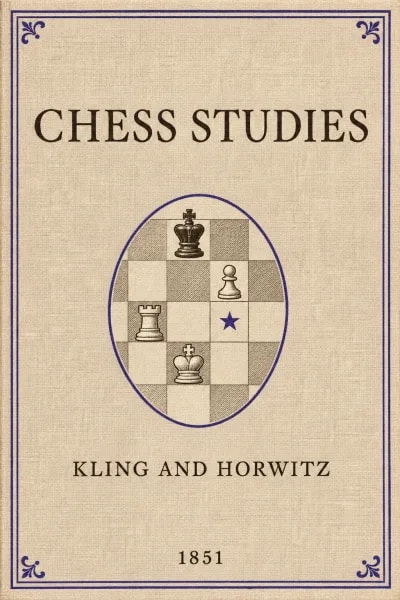
Chess Studies
or, Endings of Games · by Joseph Kling & Bernhard Horwitz, 1851
One of the foundational books of modern endgame study: over two hundred positions arranged systematically by material, starting with King and Pawns and progressing through Bishops, Knights, Rooks, and Queens, followed by the authors’ nine-game analysis of The Defeat of the Muzio Gambit.
This edition keeps the 1851 London text as printed and converts the 19th-century descriptive moves into modern algebraic notation (Nf3, not Kt. to K. B. third). Every diagram has an interactive board: click any move to inspect the position and step through main lines and variations, with modern checks noted wherever an 1851 verdict does not hold up.
Editor’s note
By Chessage, not part of the book.
Joseph Kling and Bernhard Horwitz published Chess Studies; or, Endings of Games in London in 1851, edited by Henry C. Mott. It is one of the earliest systematic collections of composed endgame studies, arranged by material from King and Pawns through Bishops, Knights, Rooks, and Queens, and closing with nine games on a new defense to the Muzio Gambit.
How to use it here: open any chapter, look at a diagram, and try to find the winning or drawing idea before clicking the first move. Most solutions are short enough to calculate in your head and check on the live board in a few minutes.
What has dated: the 1851 text uses long prose descriptive notation, which we have converted into modern algebraic moves while keeping the original wording on hover. A handful of the 1851 verdicts do not hold up under modern analysis; wherever a claimed win is actually drawn or a printed first move fails, you will find a short modern check right at the move. Start with King and Pawns.
Preface, Dedication, and Errata
Chess Studies: Endings of Games
- King and Pawns against King and Pawns27 studies
- Bishops and Pawns20 studies
- Knights, Bishops, and Pawns13 studies
- Two Minor Pieces against One Minor Piece10 studies
- Rook against Pawns10 studies
- Rook, and Rook and Pawn, against Bishop or Knight20 studies
- Rook or Rooks and Pawns against Bishops or Knights9 studies
- Rook and Bishop against Rook and Pawns, or Minor Pieces8 studies
- Rook against Three Minor Pieces7 studies
- Rook, with and without Pawns, against Similar Forces12 studies
- Queen against Pawns10 studies
- Queens and Pawns11 studies
- Queen against Rook, with and without Pawns10 studies
- Queen against Minor Pieces, with and without Pawns20 studies
- Queen and Various Forces against the Same20 studies
The Defeat of the Muzio Gambit
Keep learning
Questions
Who is Kling and Horwitz's Chess Studies best for?
+
Improving players who want focused endgame calculation practice organized by piece type. The early pawn, minor-piece, and rook chapters teach patterns that show up directly in club games.
Which edition is used here?
+
The 1851 London first edition published by C. J. Skeet and edited by Henry C. Mott, including all corrections from the book's own Errata slip. The prose is kept as printed while the moves are modernized.
Are all 207 endgame studies sound?
+
Most of them are sound, though modern analysis finds thirteen positions where the 1851 verdict is wrong and four where the printed first move throws away the result. Each of those is flagged with a short note at the move.