Free chess book
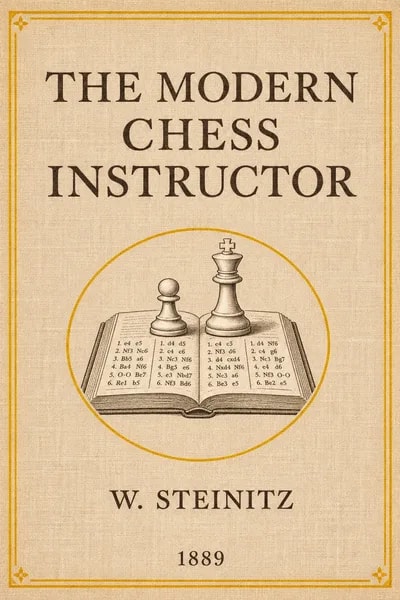
The Modern Chess Instructor
by Wilhelm Steinitz, 1889
The first world champion’s textbook of the “modern school”: the rules and notation, how to study, the relative value of the pieces and the principles of sound play, then six open games analyzed in numbered columns, each followed by illustrative games from master practice, and the games of his 1889 match with Tschigorin.
This edition keeps Steinitz’s words and changes the notation: every move is in modern algebraic notation (Nf3, not KKt–B3), replayed and checked move by move. Each column of the opening tables is printed in full with its notes beside it, and every move opens on an interactive board: click a move, then step through the line with the arrow keys or the buttons under the board.
Editor’s note
By Chessage, not part of the book.
The Modern Chess Instructor is the first world champion's own textbook. Chapters VI and VII set out the ideas that made Steinitz the founder of positional play: small advantages add up, a weak square (his "hole") can decide a game, and the King is a strong piece that can defend itself.
The rest of the book tests those ideas on six open games, from the Ruy Lopez to Philidor's Defense. Each opening is analyzed in numbered columns, as in the opening manuals of the day; here every column is printed in full with Steinitz's notes beside it, followed by illustrative games and the 1889 match with Chigorin.
Read the principles first, then pick an opening you play. Many of Steinitz's verdicts have been overturned (he disliked 3...a6 in the Ruy Lopez, now the main line), but his reasons are still worth following.
Introduction
- Preface
- Chapter I: Description of the Game. The Board and Men. Movements of Pieces and Mode of Capture
- Chapter II: The Notation
- Chapter III: The Laws of the Game
- Chapter IV: Technical Terms
- Chapter V: Chess as a Training of Mind and How to Improve
- Chapter VI: The Modern School and its Tendency
- Chapter VII: Relative Value of Pieces and Principles of Play
The Ruy Lopez
- Analysis42 columns
- Game 1: Golmayo vs. SteinitzInternational Chess Magazine, March-April double number, 1888
- Game 2: Ponce vs. SteinitzInternational Chess Magazine, May, 1888
- Game 3: Anderssen vs. Suhle
- Game 4: Steinitz vs. ZukertortInternational Chess Magazine, April-May, double number, 1886
- Game 5: Gunsberg vs. SchalloppLondon Tournament 1886
- Game 6: Steinitz vs. RosenthalLondon Chess Congress, 1883
- Game 7: Sellman vs. SteinitzInternational Chess Magazine, March, 1885
- Game 8: Tschigorin vs. ZukertortLondon Chess Congress, 1883
- Game 9: Anderssen vs. SteinitzVienna Chess Congress, 1873
- Game 10: Anderssen vs. PaulsenLondon Chess Congress, 1862
- Game 11: Anderssen vs. PaulsenSalvioli
- Game 12: Blackburne vs. SteinitzVienna Chess Congress, 1883,
- Game 13: Blackburne vs. ZukertortParis Chess Congress, 1878
- Game 14: Frankfort vs. StuttgartCorrespondence Game
- Game 15: Mackenzie vs. WinawerParis Chess Congress, 1878
- Game 16: Winawer vs. ZukertortParis Chess Congress, 1878
- Game 17: Bauer vs. PorgesInternational Chess Magazine
- Game 18: Lowenthal vs. Brien & Wormald (In consultation.)Dufresne Lehrbuch des Schachspiels
- Game 19: Neumann vs. AnderssenDufresne Lehrbuch des Schachspiels
- Game 20: Steinitz vs. BlackburneChess Match between Messrs. Steinitz and Blackburne
The Double Ruy Lopez, Four Knights' Game and Three Knights' Game
- Analysis12 columns
- Game 1: Winawer vs. ZukertortParis Chess Congress, 1878
- Game 2: Zukertort vs. SteinitzMatch, 1886
- Game 3: Max Judd vs. SteinitzInternational Chess Magazine, May, 1888
- Game 4: Paulsen vs. MorphyNew York Congress, 1857
- Game 5: Englisch vs. RosenthalLondon Chess Congress, 1883
- Game 6: Rosenthal vs. SteinitzVienna Chess Congress, 1872,
- Game 7: Blackburne vs. SteinitzLondon Chess Congress, 1883
The Scotch Gambit
- Analysis54 columns
- Game 1: Tschigorin vs. SchiffersSalvioli
- Game 2: Paulsen vs. AnderssenLeipzig Chess Congress, 1877
- Game 3: Blackburne vs. MasonDufresne Lehrbuch. Des Schachspiels
- Game 4: Zukertort vs. SchalloppLeipzig Chess Congress, 1877
- Game 5: Minchin vs. WayteDufresne Lehrbuch, Des Schachspiels
- Game 6: Mephisto vs. AmateurDufresne Lehrbuch, Des Schachspiels
- Game 7: Von Bilguer vs. Von HeydebrandSalvioli Theoria & Practica
- Game 8: Kolisch vs. HarrwitzGossip's Manual
- Game 9: Paulsen vs. ZukertortVienna Tournament 1882
- Game 10: Steinitz vs. ZukertortMatch, 1886
- Game 11: Game 11Illustrated London News
- Game 12: Vienna vs. LondonCorrespondence Game
The Two Knights' Defence
- Analysis42 columns
- Game 1: Anderssen vs. S——Dufresne
- Game 2: Dufresne vs. Von der LasaDufresne
- Game 3: Mortimer vs. St. BonSalvioli
- Game 4: Hirschfeld vs. KolischSalvioli
- Game 5: Bird vs. TschigorinVienna Congress
- Game 6: Wesel C. C vs. Crefeld C. CCorrespondence Game
- Game 7: Morphy vs. De RiviereSalvioli
- Game 8: MacCONNELL vs. ZukertortCook
Petroff's Defence
- Analysis36 columns
- Game 1: Potter vs. MasonDufresne
- Game 2: Mackenzie vs. HammondStaunton and Wormald
- Game 3: Schiffers And Tschigorin vs. Alapin And PetroffskyDufresne
- Game 4: Morphy vs. LichtenheinLowenthal-Morphy Games
- Game 5: Judd, Sellmann & Ware vs. Delmar, Moehle & Grundy
- Game 6: Anderssen vs. KolischLeipziger Schachzeitung, 1860
- Game 7: Morphy (playing 8 games simultaneously blindfold) vs. PotierLowenthal
- Game 8: Amateur vs. KieseritzkyDufresne
Philidor's Defence
- Analysis30 columns
- Game 1: Winawer vs. BlackburneVienna Congress, 1882
- Game 2: Steinitz vs. Rainer
- Game 3: Goldsmith vs. EslingSalvioli
- Game 4: Barnes vs. MorphyLowenthal
- Game 5: Bird vs. MorphyLowenthal
- Game 6: Morphy vs. Duke Of Brunswick & Count Isouard, consultingLowenthal
- Game 7: Morphy vs. HarrwitzLowenthal
- Game 8: Morphy vs. Baucher(playing 8 games simultaneously blindfold)
The Contest between Messrs. Steinitz and Tschigorin
- Analysis
- Game 1: M. Tschigorin vs. W. Steinitz
- Game 2: W. Steinitz vs. M. Tschigorin
- Game 3: M. Tschigorin vs. W. Steinitz
- Game 4: W. Steinitz vs. M. Tschigorin
- Game 5: M. Tschigorin vs. W. Steinitz
- Game 6: W. Steinitz vs. M. Tschigorin
- Game 7: M. Tschigorin vs. W. Steinitz
- Game 8: W. Steinitz vs. M. Tschigorin
- Game 9: M. Tschigorin vs. W. Steinitz
- Game 10: W. Steinitz vs. M. Tschigorin
- Game 11: M. Tschigorin vs. W. Steinitz
- Game 12: W. Steinitz vs. M. Tschigorin
- Game 13: M. Tschigorin vs. W. Steinitz
- Game 14: W. Steinitz vs. M. Tschigorin
- Game 15: M. Tschigorin vs. W. Steinitz
- Game 16: W. Steinitz vs. M. Tschigorin
- Game 17: M. Tschigorin vs. W. Steinitz
- Game 18: A. Ponce And M. Tschigorin vs. A. Gavilan And W. Steinitz
- Game 19: A. Gavilan And W. Steinitz vs. A. Ponce And M. Tschigorin
- Game 20: A. Ponce And M. Tschigorin vs. A. Gayilan And W. Steinitz
Keep learning
Questions
Is The Modern Chess Instructor good for improving players?
+
Chapters VI and VII are a clear, early statement of positional principles that still hold up. The opening columns are best read as worked examples of those principles, not as current theory.
Which edition is this?
+
Part I as published by G. P. Putnam's Sons in 1889, read from the Cornell University Library scan. Steinitz's words are kept as printed; only the notation is modernized.