The moves
Click any move to see it on the board, then step through the game with the arrow keys or the buttons under the board.
Who played it and why it's famous
Ding Liren of China, the world champion, defended his title against Gukesh Dommaraju of India in Singapore, from November 25 to December 12, 2024. The match was 14 games long. Each player had won two games, and the score was 6½ to 6½ when they sat down for game 14 on December 12. Ding had White.
The game is famous for its ending. After 54 moves the position was a draw. A drawn game would have sent the match to a tiebreak with faster games. Then Ding offered a rook trade with , and three moves later Gukesh had a won pawn ending. Ding resigned, and Gukesh became the youngest undisputed world champion at 18.
The opening
is a Reversed Grünfeld: White plays Black's Grünfeld setup, with the bishop on g2 and early castling, a move up. After Gukesh played the rare , his first surprise. After the game is equal.
avoids the trade of bishops and keeps more pieces on, playing for a win, but modern analysis rates White better afterward. kept the balance. Magnus Carlsen, commenting on the game, was critical of 13...Bb6.
The middle game
White keeps a small edge for several moves. After Ding chose , giving up a knight to trade pieces. After he gets the piece back, and the game is equal again. The trades go on, and after only a rook and a bishop each are left.
Black has an extra pawn, three on the kingside against two, but modern analysis rates the ending a draw.
The ending
For more than 20 moves Gukesh tries to make progress, and Ding defends. The black pawns reach f5 and g4, and White's pawn sits on g3. After White's bishop is far away in the corner, but the position is still a draw.
After 54...Ke5: White to play. Rook moves like Ra4 hold the draw
offers a rook trade and loses. Keeping the rooks on with or was a draw. After Black plays , the only winning move. It offers the trade of bishops, and every White move now loses: the trade leads to a lost pawn ending, and avoiding it doesn't help.
The pawn ending
leaves a king and two pawns against a king and one pawn. After Black has one winning move.
After 58. Ke3: only 58...Ke5 wins
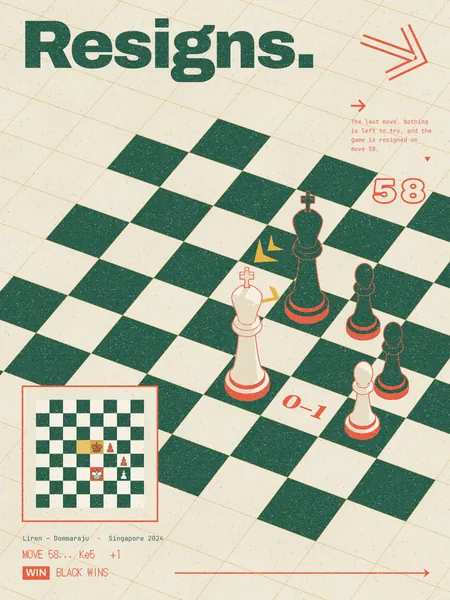
puts the black king opposite the white one, with one square between them and White to move. That is the opposition. White's king has to give way, and the black king walks around it to win the g3 pawn. or would have let White draw. After 58...Ke5 Ding resigned, and the match was over.
What to take from it
Keep pieces on when you are defending. The rook ending with bishops was a draw. Every trade made the position simpler for the side with the extra pawn, and the last trade, of rooks, decided the game.
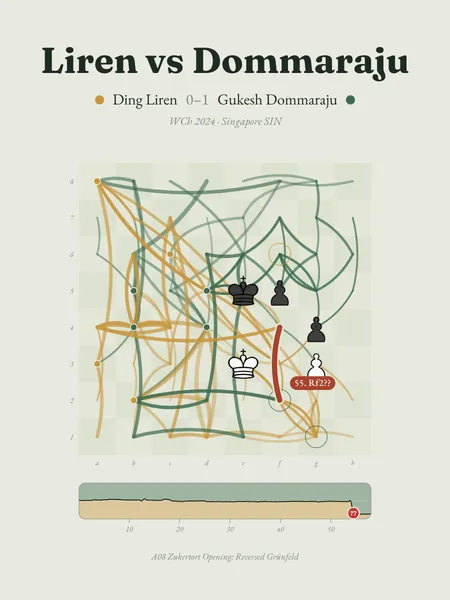
Before you trade into a pawn ending, count it out. A pawn ending can't be repaired later. With 55. Rf2 White chose one, and it was lost.
Know the opposition. The whole game came down to one king move. When kings face each other with one square between them, the side not to move holds the opposition, and in many pawn endings that is the difference between a win and a draw.
This game as a poster
Made with Posterage, our sister site: pick a style and colors, then print it.
Keep learning
- The Opposition58...Ke5 takes the opposition, the only winning move in the final pawn ending. Learn the idea before your next king and pawn ending.
- Fischer vs. Spassky, 1972, Game 6Another famous world championship game, from the match that made Fischer champion.
- Karpov vs. Kasparov, 1985, Game 16A world championship game from 1985, the match in which Kasparov took the title from Karpov.
Questions
Why was 55. Rf2 a blunder?
+
Before it the ending was a draw. 55. Ra4 or 55. Bg2 kept the rooks on and held. After 55. Rf2 Rxf2 56. Kxf2 Bd5 every White move loses. Trading bishops gives a lost pawn ending, and avoiding the trade doesn't help.
Was the pawn ending simple?
+
No. After 57. Bxd5 Kxd5 58. Ke3 Black had only one winning move, 58...Ke5, which takes the opposition. 58...Kd6 or 58...Ke6 would have let White hold the draw.
What did the win mean for Gukesh?
+
It won the match 7½ to 6½ and made him the youngest undisputed world champion in history, at 18. Only Ruslan Ponomariov, FIDE champion in 2002 while the title was divided, was younger when he won a world title.
The game score is public domain. Notes by Chessage, with every variation checked by a chess engine.