The moves
Click any move to see it on the board, then step through the game with the arrow keys or the buttons under the board.
Who played it and why it's famous
In 1971 Bobby Fischer played three Candidates matches on his way to a world title match with Boris Spassky. The first was against Mark Taimanov of the Soviet Union, in Vancouver, from May 16 to June 1. Fischer won all six games.
Game 4 was played on May 25. It was adjourned after move 41, and Fischer won it when play resumed. The game is a textbook case of a bishop beating a knight: by move 24 the queens are off, the material is level, and White's only advantage is the bishop. It became one of the best-known examples of the bishop's edge and a staple of endgame teaching.
The opening: a Sicilian Taimanov
is a Sicilian Defense, in the variation named after Taimanov himself. Fischer develops with , putting his bishop on the long diagonal. After the dark-squared bishops are traded.
clears the center, and trades the queens. White has a rook and a light-squared bishop, Black a rook and a knight, and modern analysis rates the game about equal.
The rook ending with minor pieces
is the first real mistake. Modern analysis prefers . With pawns on b6 and c5, Black's queenside is fixed on dark squares, and the light squares around them belong to White's bishop. After the bishop is on its best diagonal, hitting f7, and White is clearly better.
Fischer then improves his pieces one at a time. brings the king up, and fix the queenside, and fixes the kingside. After and Black's kingside pawns stand on f5, g6 and h5, all light squares. The bishop can attack them, and Black's pieces have to guard them.
After 41...Rd6, the sealed move: White is clearly better
was the position at the adjournment, with 41...Rd6 the move Taimanov sealed. When play resumed, let White trade the rooks on his own terms, and left a bishop against a knight. Modern analysis rates the ending as winning for White.
The king march
White's plan is to bring his king to the queenside and attack the pawn on b6. gets the king to b5, and the bishop keeps checking and probing until the black king has to stay on b7 or c7 to guard b6.
and the king reaches a6. Now the black king can't leave b6's side, and the knight has to stay near g6.
Out of moves
After 61. Be8: every Black move gives something up
The bishop attacks g6, which only the knight defends. If the knight moves, g6 falls. If the king leaves c7, the pawn on b6 falls. The pawn moves ...b5, ...c4 and ...g5 just lose a pawn. Black has to give something up, and modern analysis shows White winning after every move.
attacks the bishop, and Fischer gives it up: . Here 63. Kxb6 is the only winning move. The knight is far away on g6, and White's king eats the queenside: . Two connected passed pawns, with the king beside them, are too much for a knight, and Taimanov resigned.
Final position: the a- and b-pawns can't be stopped
What to take from it
Put your pawns on the other color from your bishop. The bishop works best when the opponent's pawns are on its color and yours are not. Here Black's pawns on f5, g6 and h5 were light-square targets for White's light-squared bishop.
Pawns on both wings help the bishop. A bishop switches wings in one move, a knight takes three or four. When the play is on both sides of the board, the long-range piece wins the race.
Win an ending by taking away moves. Fischer didn't rush. He placed king and bishop so that every Black move gave something up, and then the sacrifice on g6 finished it.
This game as a poster
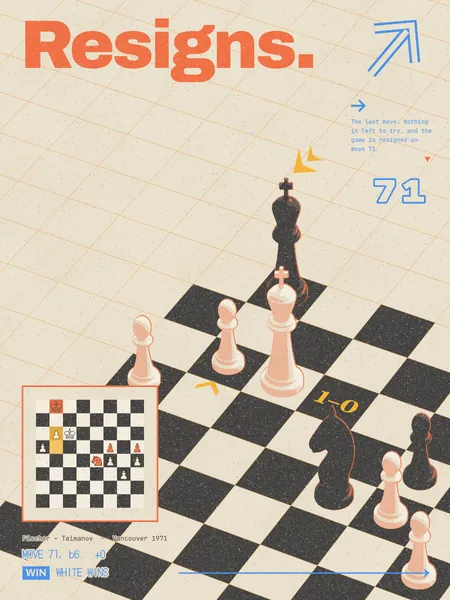
Made with Posterage, our sister site: pick a style and colors, then print it.
Keep learning
- Good and bad bishopsBlack's kingside pawns stood on light squares, the same color as White's bishop, which made them targets.
- Fischer vs. Spassky, 1972, Game 6Fischer a year later, in the match that made him world champion.
- Sicilian DefenseOur guide to 1...c5. Taimanov played the Taimanov Variation, named after him, with ...Nc6, ...e6 and ...Qc7.
Questions
Why is the bishop better than the knight here?
+
The pawns are on both wings, and a bishop moves from one side of the board to the other in one move, while the knight needs several. Black's kingside pawns on f5, g6 and h5 also stood on light squares, where White's light-squared bishop could attack them and Black's king and knight had to guard them.
What was the riddle about 42...Kd8?
+
The game was adjourned after move 41, and the question for years was whether Taimanov's 42...Kd8 threw away a draw. In 2020 the endgame expert Karsten Müller concluded, in an article for ChessBase, that Fischer was always winning in the adjourned position.
How did the match end?
+
Fischer won all six games, a 6–0 result. It was the first of his three Candidates matches in 1971, and in 1972 he beat Boris Spassky for the world title.
The game score is public domain. Notes by Chessage, with every variation checked by a chess engine.