The moves
Click any move to see it on the board, then step through the game with the arrow keys or the buttons under the board.
Who played it and why it's famous
In 1999 Garry Kasparov, the world champion, played a game over the internet against everyone who wanted to join in. He had White and played alone. The World Team's moves were chosen by plurality vote, at a pace of about one move a day. More than 50,000 people from over 75 countries took part.
Four young players posted a recommended move before each vote: Étienne Bacrot, Florin Felecan, Irina Krush and Elisabeth Paehtz. The voters argued over every line on a bulletin board, and Krush kept a tree of the team's analysis. Kasparov played his first move on June 21, and the World Team resigned on October 22, after 62 moves. Kasparov later called it the greatest game in the history of chess.
The opening: a Sicilian with 3. Bb5+
is the Sicilian Defense. After Kasparov chose , a quieter way than the main lines. After White has pawns on c4 and e4, a grip on d5.
was a new move, found by Krush. It hits the pawns on c4 and e4 at once, and it is modern analysis's top choice here, with the game about equal. Kasparov went straight for it: . White has won a rook for a knight, and Black has two pawns and a king in the middle. After it is still about equal.
The middle game
Both sides attack. Black's pieces go after White's queenside pawns, , and White's queen takes Black's kingside pawns, . That leaves passed pawns on both wings. The World Team kept choosing the sharp option: won the vote over 26...Bc5 by less than half a percent, and modern analysis rates the two moves about the same.
After the queens are off, and the race of the passed pawns begins. was a real slip: modern analysis prefers . After 37...e6 White is winning with , but Kasparov played , and the game was close again.
The race to queen
and both sides push. White's h-pawn reaches h7, Black's b- and d-pawns run down the board, and Kasparov's king walks to f5 and g6 to help. After both sides have a queen.
After 50...d1=Q: both sides have a new queen, and the ending is a draw
White has one pawn, on g5, close to queening. Black has two, still far back on b7 and d6. Modern analysis shows this ending is a draw with best play. At move 51 the World Team, for the first time in 40 moves, did not follow Krush's suggestion of 51...Ka1 and played . Both moves hold the draw.
The queen ending
is still a draw, and 53...Ka1 is the only drawing move. Then came the decisive moment.
After 54. Qf4: only 54...Qd3 or 54...Qd5 holds the draw
gives up the b-pawn to free the f-file for checks, and it loses. or 54...Qd3, keeping the queen in the center, would have held. From here Kasparov found the only winning move four times in a row: .
On move 58 the team chose by 49 percent to 44 for 58...Qf5, the move the bulletin board preferred. Krush's recommendation for Qf5 had reached the site late. Modern analysis shows both moves lose. After the pawn reaches the seventh rank with the king beside it, and the World Team resigned. With best play Black is mated in 28 moves.
What to take from it
In a queen ending, centralize your queen. The drawing moves at move 54, Qd5 and Qd3, put the queen in the middle of the board, where it can check from many sides. 54...b4 gave a pawn to check from the f-file, and the checks ran out.
Count the race before you start it. From move 31 both sides pushed passed pawns. Count how many moves each pawn needs, and remember that a rook can give itself up for a pawn: Kasparov gave his rook for Black's new queen at move 48 and still queened himself two moves later.
Keep your king next to your passed pawn. In the queen ending White's king walked with the g-pawn, to g7 and f6, and the pawn went through.
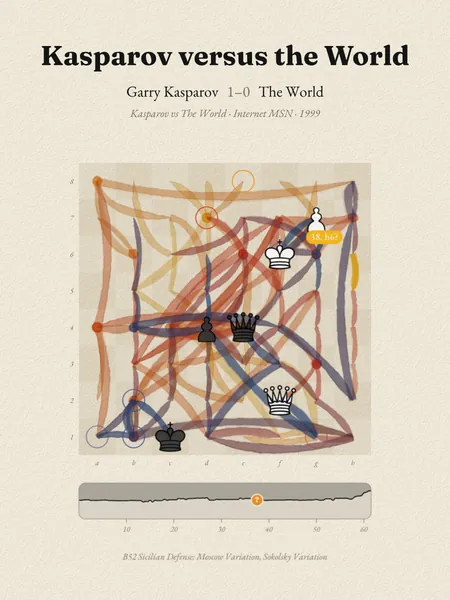
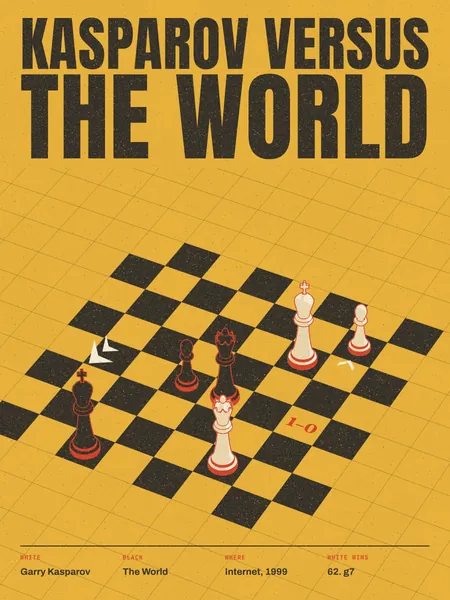
This game as a poster
Made with Posterage, our sister site: pick a style and colors, then print it.
Keep learning
- Sicilian DefenseOur guide to 1...c5, the World Team's first choice. Kasparov's 3. Bb5+ is a way to sidestep the main lines.
- Kasparov's ImmortalKasparov's most famous over-the-board game, played six months earlier at Wijk aan Zee.
- Queen vs. pawnThe simplest race ending, a queen against a pawn about to promote. Learn it before you try queen endings like this one.
Questions
How was the game played?
+
Over the internet, hosted by MSN Gaming Zone. Kasparov played White alone. The World Team's moves were chosen by plurality vote, and more than 50,000 people from over 75 countries took part. The pace was about one move a day, so the 62 moves took from June 21 to October 22, 1999.
Who helped the World Team?
+
Four young players recommended moves before each vote. Étienne Bacrot was 16, Florin Felecan 19, Irina Krush 15 and Elisabeth Paehtz 14. Grandmaster Daniel King commented on the game, and the voters argued over lines on a bulletin board, where Krush kept a tree of the team's analysis.
Where did the World Team go wrong?
+
Modern analysis shows the queen ending was a draw after move 50. The first losing move was 54...b4. Either 54...Qd3 or 54...Qd5 would have held. After 54...b4 Kasparov found the only winning move four times in a row.
The game score is public domain. Notes by Chessage, with every variation checked by a chess engine.