The moves
Click any move to see it on the board, then step through the game with the arrow keys or the buttons under the board.
Who played it and why it's famous
The game was played in round 1 of the open section of the Hoogovens tournament at Wijk aan Zee, in the Netherlands, in January 1995. White was Roberto Cifuentes Parada, a Chilean grandmaster who had moved to the Netherlands and played for it at the time. Black was Vadim Zvjaginsev, an 18-year-old grandmaster from Moscow.
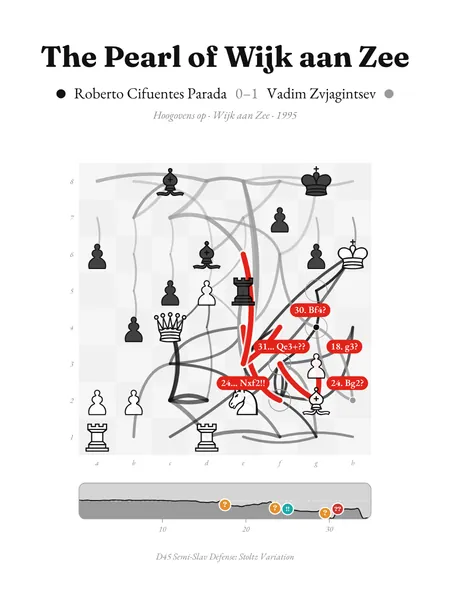
The game is famous for its last twelve moves. Black gives up a knight on f2, a rook on e3 and finally his queen on e3, and the white king is driven out of its castle, from g1 to f2, f3, g4, g5 and h6. When White resigns, Black has two different mates in one.
The opening: a Semi-Slav
is the Semi-Slav Defense: pawns on c6, d5 and e6 make a solid triangle in the center. After Black puts his light-squared bishop on the long diagonal, behind the c6 pawn.
White breaks in the center with . Now White has a passed pawn on d5. It cramps Black, but it also blocks the long diagonal only until it falls, and it needs looking after.
The middle game
Both sides aim at the kings. White's bishop on h6 and knight on h4 point at the black king, and Black's bishop on d6 eyes h2.
is a slip. It shuts out the bishop on d6, but it loosens the squares around White's king, and modern analysis prefers . After Black is better: the queenside pawns start to roll with , and a black knight settles on e4, where it eyes f2.
White regroups with . The knight from h4 comes back to e3 to guard the d5 pawn, and the game is about equal again. But Black's knights on e4 and f6, the rook on e8, the queen and the bishop on b7 all point at the white king.
The combination
After 24. Bg2: Black to play and win
is the start, and it is Black's only winning move. Other moves keep the game about equal at best. The knight on e4 takes on f2, and White's king has to deal with it. is the best of White's choices: is even worse.
follows at once. It is the only way to go on: after 25...Re5 instead, White would be better. Black gives the rook for the knight on e3, the piece that guarded g4. After the second knight jumps in with check.
goes forward. Modern analysis prefers , which gives back the bishop on e3 but keeps the king at home. Black would still be winning. After White must not try , which loses at once to . brings the king back to f3, and now Black finds a quiet move.
The king hunt
brings the queen to the e-file, where it hits the bishop on e3. It is one of several winning moves. makes it quick: the bishop steps out of the queen's line, but after it Black is winning outright. , offering a queen trade, was the stubborn try.
brings the last rook to the e-file. After Black plays the move the game is remembered for.
After 31. Qc4: Black to play and mate in six
gives up the queen, and modern analysis shows mate in six from here. lures the bishop to e3, where the rook takes it with check: . Taking the knight instead, , is mated even faster. Now White's dark-squared bishop is gone, and the king stands alone on g4. goes on, because allows . is again forced, since runs into .
is the quiet finish, and White resigned. The rook threatens 36...Rh5#, and the bishop on d6 threatens 36...Bf8#. White can't stop both.
Final position: Black threatens both Rh5# and Bf8#
What to take from it
Count the defenders, then remove them. The knight on e3 and the bishop on e3 guarded White's king. Black gave a rook for the first and a queen for the second, and the king had nothing left.
Checks first. From move 26 to move 34, most of Black's moves give check. A king in check can't defend anything else, so the attacker keeps the time to bring in more pieces, here the queen and the second rook.
A quiet move in an attack can be the strongest. 29...Qe6 and 35...Re5 give no check at all. Both bring one more piece into the attack, and the second one leaves White with two mates to stop and only one move.
This game as a poster
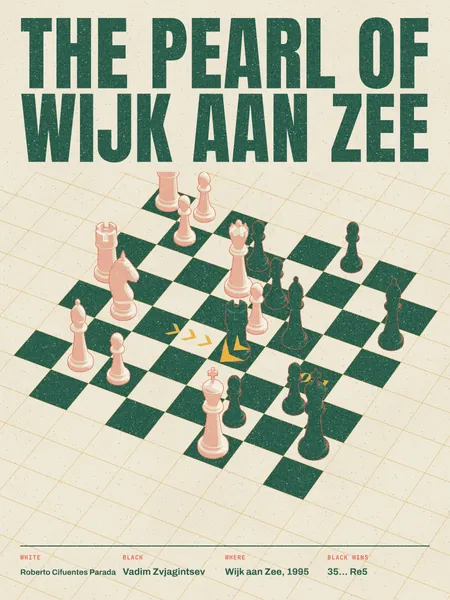
Made with Posterage, our sister site: pick a style and colors, then print it.
Keep learning
- Decoy31...Qe3+ lures White's dark-squared bishop to e3, where the rook takes it with check and the king is left in the open.
- Kasparov's ImmortalFour years later, at the same tournament, another king is chased up the board, this time from a7 to d1.
- Edward Lasker vs. Thomas, 1912The classic king hunt, a king dragged from g8 all the way to g1.
- Queen's GambitOur guide to 1. d4 d5 2. c4. Its White course has an answer to the Semi-Slav, the defense Black chose here.
Questions
Why is it called the Pearl of Wijk aan Zee?
+
The nickname names the place. The game was played in round 1 of the open section of the Hoogovens tournament at Wijk aan Zee, in the Netherlands, in January 1995, and Black's attack from move 24 on is one sacrifice after another.
Where did White go wrong?
+
At move 24. Before 24. Bg2 the game was about equal, and modern analysis prefers 24. h4. After 24. Bg2 Black is winning, but only with 24...Nxf2. Later, 30. Bf4 sped up the end. 30. Qe4, offering a queen trade, held out longer, though Black was still winning.
Did White have to take everything?
+
Mostly, yes, and declining didn't help. After 24...Nxf2, 25. Rd2 was even worse than taking the knight. After 25...Rxe3, taking with the king, 26. Kxe3, was a little more stubborn than 26. Bxe3, but Black was winning either way. The last sacrifice, 31...Qe3+, forces mate in six moves.
The game score is public domain. Notes by Chessage, with every variation checked by a chess engine.