The moves
Click any move to see it on the board, then step through the game with the arrow keys or the buttons under the board.
Who played it and why it's famous
Alexander Alekhine was the world champion, and Max Euwe of the Netherlands was his challenger. Their 1935 match was played over 30 games in towns across the Netherlands, from October 3 to December 16. Euwe scored only one point from the first four games and was three points behind after game 9. He took the lead for the first time in game 25.
Game 26 was played on December 3 in Zandvoort. Euwe gives up a knight for three pawns, then the exchange, and his center pawns decide the game. Savielly Tartakower called it the pearl of Zandvoort. The win put Euwe two points ahead with four games left, and he went on to win the match by a point.
The opening: a Dutch Defense
Alekhine chose the Dutch Defense, against the leading Dutch player, in the Netherlands. brings a knight to e4 at once.
is a mistake. It allows , and modern analysis rates White clearly better. Euwe chose , which keeps a smaller edge.
trades a pair of knights and the light-squared bishops. After the center is closed. Black's pawns stand on c5, d6, e4 and f5, and modern analysis rates the position about equal.
The knight sacrifice
After 20...Bf6: Euwe gives up his knight on f5
gives up the knight. After the knight has taken three pawns, on f5, d6 and e4, and it is still alive on e4. Black has the extra piece. White has a passed pawn on d5 and more pawns in the center.
Modern analysis rates the sacrifice sound and the position about equal. Quiet moves such as were just as good. The sacrifice changed the kind of game: from now on Black's extra piece fights against a mass of white pawns.
opens Black's own king. Modern analysis prefers , with an equal game. After the pawn on e6 attacks the knight on d7, and White's pawns are rolling.
The exchange sacrifice
After 29...Qg6: Euwe gives up the exchange on g1
gives up a rook for Black's strong bishop: . Modern analysis prefers , which kept White better. After the exchange sacrifice the game is about equal again.
brings the knight to e6, where the pawn on d5 protects it. offers a queen trade. Modern analysis prefers keeping the queens with , but after White has a pawn on e5 and a knight on e6, and Black's rooks must stop them.
Alekhine's mistakes
Black's way out was to give the exchange back with , and modern analysis rates that ending about equal. Alekhine kept his extra rook with . gave him a second chance, since was stronger, but was the decisive mistake. still held the balance.
brings the pawn to e7, one step from queening, and the knight on c6 guards e7 and d8. White is winning. After Black finally takes the pawn, but checks the king and attacks the rook on d2. Alekhine resigned.
Final position: 47. Ne4+ forks the king and the rook on d2
The knight that gave the last check started the game on g1. Euwe made 19 of his 47 moves with it.
What to take from it
Pawns can be worth a piece. After 23...Bf6 White had three pawns for the bishop, and his d- and e-pawns became a passed pair in the center. Count what the pawns can do, not just how many there are.
Give material back to stop a pawn. Alekhine had a rook for a knight and pawns, and twice he could have returned the exchange on e6. Holding on to it let the e-pawn reach e7.
A knight and a passed pawn make a strong team. The knight escorted the e-pawn: from d8 it guarded e6, from c6 it guarded e7, and from d6 it covered the queening square e8 and was one jump from the final fork.
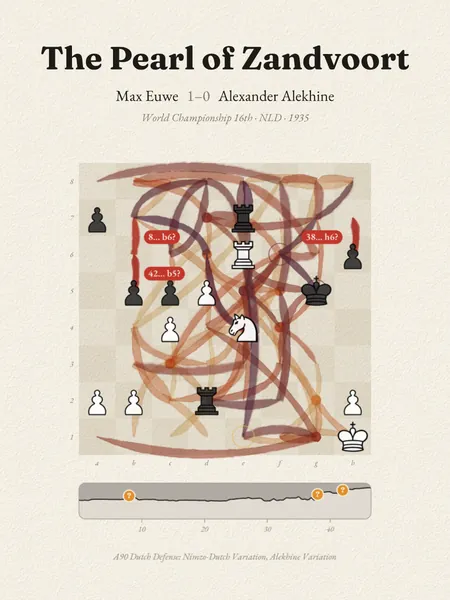
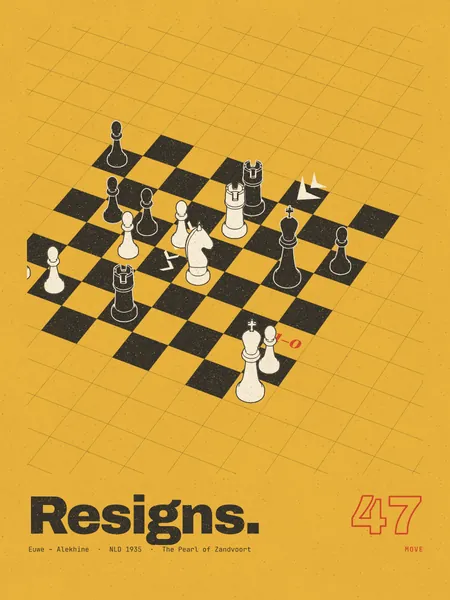
This game as a poster
Made with Posterage, our sister site: pick a style and colors, then print it.
Keep learning
Questions
Why is it called the Pearl of Zandvoort?
+
The game was played in Zandvoort, one of the Dutch towns that hosted the 1935 match, and Savielly Tartakower called it the pearl of Zandvoort. It is usually counted as the most beautiful game of the match.
Was Euwe's knight sacrifice sound?
+
Yes, but it didn't win by force. Modern analysis rates the position about equal after 21. Nxf5 and again after the exchange sacrifice on move 30. The game was decided later, when Alekhine kept his extra rook with 37...Rf5 and 38...h6 instead of giving it back on e6.
Did Euwe win the match?
+
Yes. He led 14–12 after this game and won the match 15½–14½ in December 1935, after trailing by three points as late as game 9. Alekhine won the title back in a rematch in 1937.
The game score is public domain. Notes by Chessage, with every variation checked by a chess engine.