The moves
Click any move to see it on the board, then step through the game with the arrow keys or the buttons under the board.
Who played it and why it's famous
Alexander Petrov was the first great Russian chess master, and for more than half a century he was counted the strongest player in Russia. In 1824 he published a chess handbook, one of the first in Russian, and the opening 1. e4 e5 2. Nf3 Nf6, which he analyzed with Carl Jaenisch, still carries his name: Petrov's Defense.
This game against Alexander Hoffmann, from Warsaw in 1844, is the one people remember him by. It is a game of the Romantic era, and it shows why. Black gives up a knight to drag the white king into the open, White takes everything offered, and Black answers by leaving his queen to be taken.
The opening: a Giuoco Piano
is the Giuoco Piano, the oldest main line of the Italian Game. is White's classical plan: c3 and d4 to build a big center. The pawn on e5 kicks the knight on f6, and White hopes to rebuild his center with cxd4.
Here Black has one good answer: , hitting the bishop on c4, and the position is equal. is a mistake. Modern analysis rates White clearly better after it.
A knight for three pawns
is the strongest reply. The bishop attacks the knight on e4, and the knight has no safe square to go to. Black can defend it with 7...f5, or give it up for a pawn and a check, and modern analysis rates the two about the same. Petrov gives it up: .
Black has three pawns for the knight, and the white king has walked out to g3. That looks dangerous, but modern analysis still rates White clearly better. His pieces are out, and Black's are not. Black's next move, , heads for d5 or f5 to trade off the bishop on d5 or check the king.
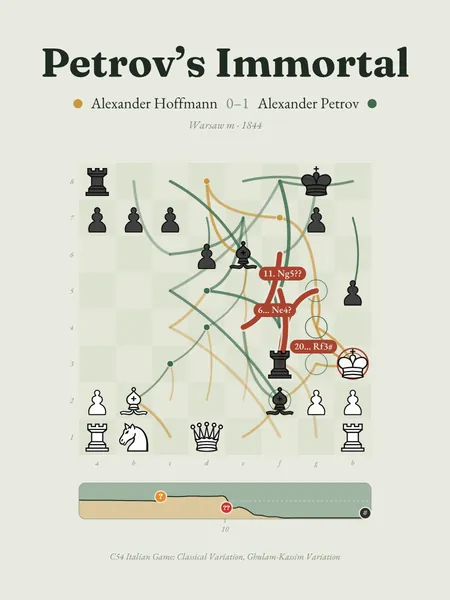
After 10...Ne7: the white king stands on g3, and White has to decide how to protect it
The mistake: 11. Ng5
is the move that loses. It aims at f7 and h7, but it takes the knight off f3, where it guarded the king. A quiet move was needed. , for example, gives the king the h2 square, and after White stays clearly better.
After the game's move Black is winning. takes the bishop, and forks the queen on d8 and the rook on h8.
12...O-O, leaving the queen
is the move that made the game famous. Black castles, saves the rook from the fork and puts it on the f-file, and leaves the queen on d8 to be taken. Modern analysis shows it is by far Black's best move. , saving the queen, leaves Black better but nowhere near as close to a win.
After 12...O-O: the black queen on d8 is attacked, and Petrov leaves it there
White did not have to take. loses too, but more slowly. grabs the queen and allows a forced mate. Almost every Black move from here on is a check.
The king hunt
After , is a discovered check. The pawn steps off d7, and the bishop on c8 now aims straight at h3. blocks with the pawn, and brings the knight back into the attack and takes the blocking pawn.
makes the end quicker. was the more stubborn defense, but it only delays the mate. After the king is back on h3.
The mate
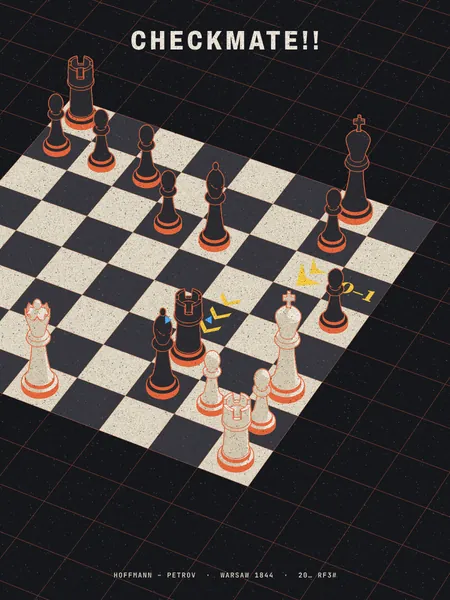
is a double check. The rook gives check along the third rank, and by leaving f5 it uncovers the bishop on e6, which checks along the diagonal to h3. Against a double check only a king move can help, and the king has none: the bishop on f2 covers g3 and h4, the bishop on e6 and the pawn on h5 cover g4, and the king's own pawns stand on g2 and h2.
Final position: the white king is mated on h3 by a double check
White still has his queen, and Black gave his up eight moves earlier. But the white queen on d1 and the rooks on a1 and h1 never moved in the whole game.
What to take from it
Play the move your position needs. After 6. e5, only 6...d5 kept Black level. Against a pawn that kicks your knight, look first for the counterattack in the center.
Count the defenders around your king. White's king on g3 was safe only while his pieces stayed near it. 11. Ng5 sent the knight away to attack, and Black's pieces came in at once.
A queen is only material. Petrov gave up his queen because his rooks, bishops and knight could all reach the white king, and White's queen could not help. When you look at a sacrifice, compare the pieces that can take part, not the totals.
This game as a poster
Made with Posterage, our sister site: pick a style and colors, then print it.
Keep learning
- Italian GameOur guide to 1. e4 e5 2. Nf3 Nc6 3. Bc4. This game is its oldest main line, the Giuoco Piano with 3...Bc5, 4. c3 and 5. d4.
- Petrov's DefenseThe opening named after Black in this game, 1. e4 e5 2. Nf3 Nf6, which he analyzed with Carl Jaenisch.
- The king huntHow to drag a king out of its shelter with checks, as Petrov does from move 13 on.
- Double checkThe final move, 20...Rf3#, is a double check. Only a king move could answer it, and the king had none.
Questions
Who was Alexander Petrov?
+
Alexander Petrov (1794–1867) was the first great Russian chess master and for more than half a century the strongest player in Russia. In 1824 he published a chess handbook, one of the first in Russian, and Petrov's Defense, 1. e4 e5 2. Nf3 Nf6, is named after him.
When was the game played?
+
Most sources give Warsaw, 1844, from a long series of games between Petrov and Alexander Hoffmann. J. H. Ellis's 1895 collection Chess Sparks prints the same moves as played "about 1860". The score itself is the same in every source we checked.
Could White have saved the game?
+
Not after move 11. Modern analysis shows White clearly better after 10...Ne7, for example with 11. h3, but 11. Ng5 lets Black win. Once Black castled on move 12, refusing the queen with 13. Rf1 would only have lost more slowly. Taking it with 13. Nxd8 allowed a forced mate.
The game score is public domain. Notes by Chessage, with every variation checked by a chess engine.