The moves
Click any move to see it on the board, then step through the game with the arrow keys or the buttons under the board.
Who played it and why it's famous
The Candidates Tournament of 1953 ran from August 29 to October 24 in Switzerland. Fifteen players met twice each, and the winner earned a match with the world champion, Mikhail Botvinnik. Samuel Reshevsky of the United States and Tigran Petrosian of the Soviet Union met in round 2.
The game is famous for one quiet move. In a position where White was pushing forward, Petrosian put a rook on e6, where White's bishop could take it, and let it go. He got only a bishop for it, but his knight reached d5 and stopped White's play. Mikhail Tal later wrote that this "purely positional sacrifice" made "an indelible impression" on him. Petrosian became known for exchange sacrifices like this one.
The opening: a Nimzo-Indian
is the Nimzo-Indian Defense. Black pins the knight on c3 and is ready to trade his bishop for it. After he does, and White gets the two bishops and doubled c-pawns.
locks the queenside. Black's pawn on c4 fixes White's c3 pawn, but it also takes the pressure off d4, and White is free to push in the center with f3 and e4. That is what Reshevsky does: .
White takes the center
gives White two strong pawns on d4 and e4, a half-open f-file and a queen aimed at the kingside. Black answers on the queenside with , but White's play comes first. brings the bishop to the c8–h3 diagonal, and lines up White's rooks behind the e-pawn. Modern analysis rates White better.
After 25. Rfe1: White is better. Black to play
The exchange sacrifice
The trouble for Black is his knight on c6. It has no good square, and it can't get to d5, the one square where it would stop the d- and e-pawns, without help. So Petrosian plays . The rook blocks the e-pawn, and it stands where the bishop on g4 can take it. Black will get only a bishop back, but the bishop is White's best attacking piece.
Modern analysis rates 25...Re6 as Black's best move. White is still better after it, and he should keep up the pressure with or take at once with . Instead spends a move on the queenside, and after the knight is on its way. and the game is close to level.
The knight on d5
is the point. The pawn on e6 guards the knight. White's e-pawn has already gone past e4, and his c-pawn is stuck behind Black's pawn on c4, so no white pawn can chase it away. From d5 the knight hits c3, e3 and f4 and blocks the d4 pawn. White's attack has stopped.
After 28...Nd5: the knight is safe on d5, and modern analysis rates the game about equal
Reshevsky gives the material back at once. attacks the queen on f1, and White has to answer : other moves leave Black better. trades rook for bishop and wins Black's c-pawn. White is now a pawn up, but the pawns on the queenside are traded with , and each side gets a passed pawn: White on the a-file, Black on the b-file.
The finish
and the players agreed a draw. White's a-pawn is held by the rook on a8 and the queen on b6, Black's b-pawn by the rook on b1, and the knight on d5 still blocks the center.
Final position: the passed pawns hold each other, and the game was drawn
What to take from it
An exchange is not a fixed price. A rook is usually worth more than a bishop, but here White's bishop on g4 was his best attacking piece and Black's rook had nothing to do. Count what the pieces do, not only what they are worth.
Find the square, then pay for it. Petrosian's plan was a knight on d5, guarded by a pawn and safe from White's pawns. When the plan needs a square and a rook stands in the way, sometimes the rook has to go.
Defense can be active. 25...Re6 made no threat at all, but it changed the position so much that White's attack had no target left.
This game as a poster
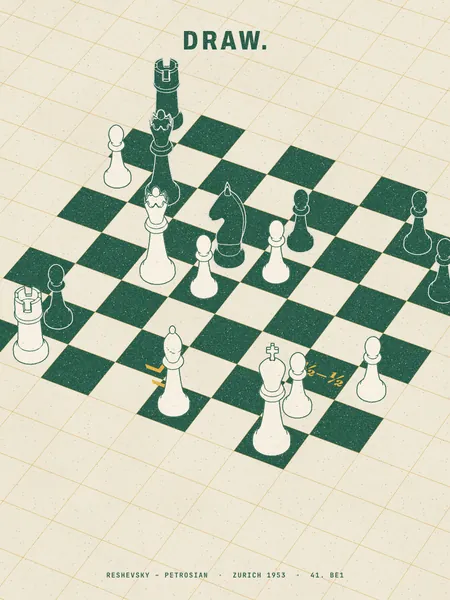
Made with Posterage, our sister site: pick a style and colors, then print it.
Keep learning
Questions
Why did Petrosian give up the exchange with 25...Re6?
+
White's bishop on g4 and his pawns on d4 and e5 were the core of his attack. The rook on e6 blocked the e-pawn and offered itself to the bishop. After 27. Bxe6 fxe6 the bishop was gone, the pawn on e6 covered d5 and f5, and the knight settled on d5, where no white pawn could chase it away.
Was 25...Re6 a good move?
+
Yes. Modern analysis rates it as Black's best move in a difficult position. White stays better after it, but less so than after the other tries, and one slip, 26. a4, let Black equalize.
Who won the tournament?
+
Vasily Smyslov, with 18 points out of 28. Reshevsky, David Bronstein and Paul Keres shared second place with 16, and Petrosian was fifth with 15. Smyslov went on to play Mikhail Botvinnik for the world title in 1954.
The game score is public domain. Notes by Chessage, with every variation checked by a chess engine.