The moves
Click any move to see it on the board, then step through the game with the arrow keys or the buttons under the board.
Who played it and why it's famous
China played its first Chess Olympiad in Buenos Aires in 1978, two years after the end of the Cultural Revolution. In round 8 China met the Netherlands, and Liu Wenzhe faced Jan Hein Donner, a Dutch grandmaster and three-time Dutch champion. The game was played on November 2, 1978.
It is known as the Chinese Immortal. Liu pushes his g- and h-pawns at the black king, brings his queen to the h-file and sacrifices it on g6. Two bishops and a pawn then drive the king into a mating net. Donner resigned after 20 moves. It remains Liu's best-known game, and he went on to become one of China's leading coaches.
The opening: a Pirc with 5. g4
is the Pirc Defense. Black lets White build a big center and plans to strike at it later from the flanks. is an aggressive idea: the g-pawn runs at the knight on f6 before Black has castled. The line is now called the Chinese Variation.
Modern analysis rates 5. g4 as about equal, as long as Black hits the center at once with . Donner chose , stopping g5 for now, and after White's pawn on d5 gains space.
Castling into the storm
castles right into the pawns. Modern analysis prefers , keeping the king in the center for a while, and White is only slightly better. After castling, White knows where to attack.
is the strongest move. The h-pawn comes to support g5. After the h-file is open. White hasn't castled, and that helps: the rook on h1 already stands on the open file, aimed at h8 and h7.
After 10. hxg5: the h-file is open, and the white rook is already on it
is passive. It takes the knight away from the kingside and blocks the f8 rook. Modern analysis prefers , which still leaves White clearly better. After Ne8, White is much better.
is the best move. The queen heads for g3 and the h-file. and she is one step from h4.
The decisive mistake
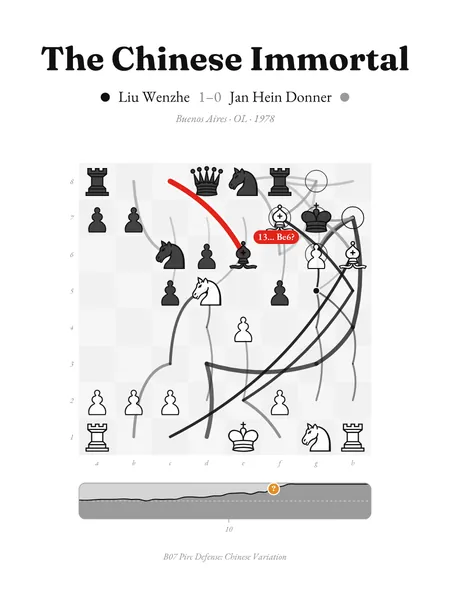
develops a piece but does nothing about the h-file. Black had to break with at once, giving the king some air. White would still be close to winning, but Black could fight on.
reaches the h-file. The threat is Qh7 mate, since the knight left f6 and nothing else guards h7. Most Black moves allow it at once, and modern analysis shows White winning against every defense. gives the king f7, and is forced.
The queen sacrifice
After 15...Kf7: White gives up the queen on g6
is the move people remember. The pawn on g6 shielded the king, and the queen takes it. It is the only move that mates. Other moves leave White much better, but give Black time to defend.
Black can't decline. After White mates at once with . So Donner took: , and the black king is out in the open on g6.
is the only good check. The tempting lets the king escape, and then Black is winning. After the bishop steps off the h-file and uncovers check from the rook on h1. It also takes g8 and g6 from the king, and blocks the file. Then and Donner resigned.
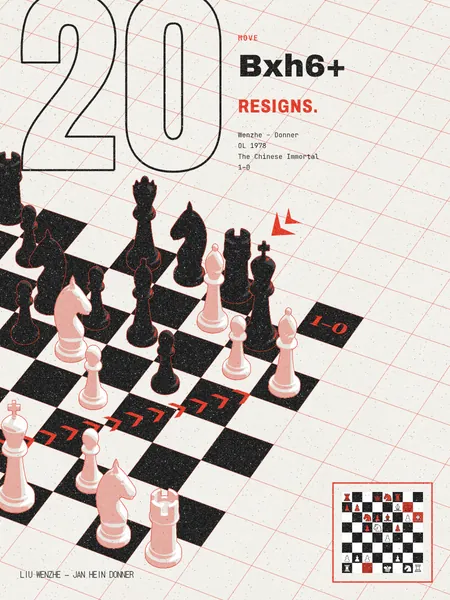
Final position: Black resigned, facing mate in two
The rook on h1 has never moved, and now it finishes the game. After it gives mate down the h-file.
What to take from it
Castle away from the pawns. When your opponent has pushed pawns toward one side, castling there gives them a target. Donner's 7...O-O told White exactly where to attack.
An open file needs a rook. White never castled, so the rook on h1 stood on the h-file from the start. When the pawns opened it, the rook was already in place for the mate.
Keep defenders near your king. 10...Ne8 moved the f6 knight away, and h7 lost its main defender. Every move later, Black had one piece too few on the kingside.
This game as a poster
Made with Posterage, our sister site: pick a style and colors, then print it.
Keep learning
- Pirc DefenseOur guide to 1. e4 d6 2. d4 Nf6 3. Nc3 g6, the opening Donner chose. Liu's 4. Be2 and 5. g4 is now called the Chinese Variation.
- Attacking the exposed kingLiu's pawn storm opened the h-file in front of Black's king. Learn how to attack a king without its pawn cover.
- Sacrificing for checkmate16. Qxg6+ gives up the queen to drag the king out to g6, where it is mated. Practice sacrifices like it.
Questions
Why did Donner resign after 20. Bxh6+?
+
Black is mated next move or the one after: 20...Kh8 21. Bxf8+ Qh4 22. Rxh4# is one line. Modern analysis confirms mate in two at most.
Where did Black go wrong?
+
Castling with 7...O-O put the king in front of White's g- and h-pawns, and 10...Ne8 took a defender away from the kingside. The decisive mistake was 13...Be6. Black had to play 13...f5 at once. After 13...Be6 14. Qh4, modern analysis shows White winning whatever Black plays.
Who was Liu Wenzhe?
+
A Chinese player and coach (1940–2011). He was the first Chinese player to beat a grandmaster, Nikolai Krogius in 1965, and the first from China to earn the International Master title. Later he was head coach of the Chinese national team.
The game score is public domain. Notes by Chessage, with every variation checked by a chess engine.