The moves
Click any move to see it on the board, then step through the game with the arrow keys or the buttons under the board.
Who played it and why it's famous
Boris Spassky was the world champion and Bobby Fischer the challenger. Fischer had lost game 11 with the Sicilian Defense, and before game 13 he led the match 7–5. The game began on August 10, 1972, and was adjourned after 41 moves, with Spassky sealing his 42nd move. Fischer stayed up analyzing until 8 a.m. and won it when play resumed the next afternoon.
It is famous for its ending. Fischer gives up his bishop for a pawn, lets his rook get shut in on g8, and plays five passed pawns against White's rook. Mikhail Botvinnik called it Fischer's highest creative achievement, and David Bronstein said that of all the games in the match, the 13th appealed to him most. After Spassky resigned, he stayed at the board for a long time.
The opening: an Alekhine Defense
is the Alekhine Defense. Black lets White's pawns chase the knight and plans to attack them later. After Black fianchettoes the bishop, which will press on White's pawn on e5.
and the game is level. Then lets Black take a pawn: . Modern analysis prefers , keeping the balance. Now Black is a pawn up and slightly better.
The middle game
weakens White's kingside to drive the bishop. Modern analysis prefers . After White has space, but the black bishop on d5 and the extra a-pawn leave Black slightly better.
trades the queens. Now each side has one bishop, on different colors, and White has a passed pawn on d6. Modern analysis rates Black much better, but the ending is far from simple.
and the game was adjourned.
After 41...Bd5: the position at the adjournment, with Black better but no clear win
The white pawn on d7 is one step from queening. Black's a-pawn is one step too, but the bishop on f6 watches a1. Spassky sealed , the best move.
The bishop for a pawn
and Fischer had to deal with the d7 pawn.
takes it and leaves the bishop on d5 to be captured. It is the only move that keeps Black on top. lets White play d8=Q, and then White is winning. After White has a rook and bishop against a rook, but Black has five pawns to White's two.
is a race. White's g-pawn reaches g7 first, and guards it.
After 61. Bf8: the black rook is shut in on g8, and five black pawns face the white rook
Black's rook can't leave g8, or the pawn queens. So the fight is White's rook and king against five black passed pawns on a2, b4, c4, f5 and h3, and the black king.
The missed draw
gives up the h-pawn to bring the king forward. From move 62 on, modern analysis rates the game a draw with correct defense. and Spassky had to find the right check.
draws. After the rook takes the f-pawn with check, and Black can't make progress.
Spassky played , and was the only winning reply. After the f-pawn runs. made it worse, where was more stubborn. frees the rook at last, and after Spassky resigned.
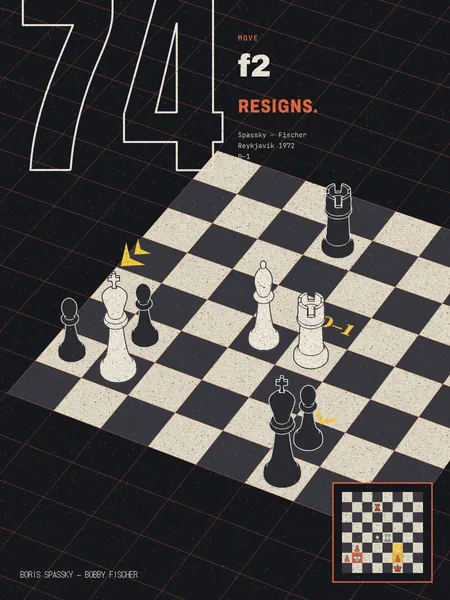
Final position: the f-pawn threatens to queen
The rook trade doesn't save him: and the pawn promotes.
What to take from it
A piece can be worth less than a pawn. Fischer's 49...Kxd7 gave up a bishop to remove the d7 pawn, because that pawn was about to queen. Ask what each piece and pawn will do, not what it's worth on paper.
Passed pawns stretch a rook. Five black pawns, with the king behind them, kept White's rook busy everywhere at once. The defense held only with exact moves, and one slip was enough.
In a long defense, check every check. Spassky held for 20 moves and then chose the wrong check on move 69. When a position is close to a draw, compare every forcing move before you play one.
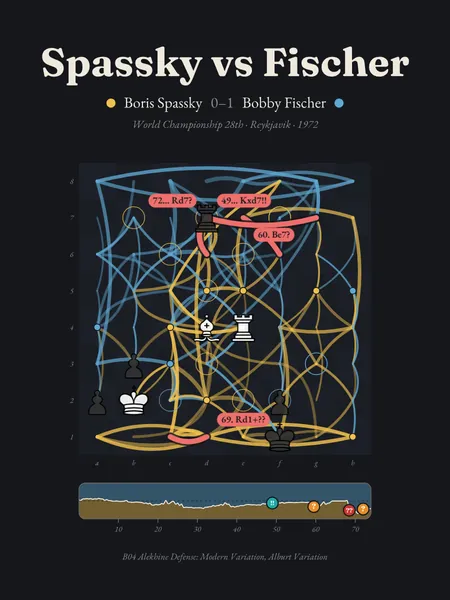
This game as a poster
Made with Posterage, our sister site: pick a style and colors, then print it.
Keep learning
- Alekhine DefenseOur guide to 1. e4 Nf6, the opening Fischer chose for this game after losing game 11 with the Sicilian.
- Opposite-colored bishopsAfter 31. bxc3 each side had one bishop, on different colors, the kind of ending that is often drawn. Learn why.
- Fischer vs. Spassky, 1972, Game 6The same match, a month earlier. Fischer wins a Queen's Gambit with a kingside attack and takes his first lead.
Questions
Where did Spassky miss the draw?
+
On move 69. Instead of 69. Rd1+, the check 69. Rc3+ holds: after 69...Kd4 70. Rf3 c3+ 71. Ka1 c2 72. Rxf4+ White wins the f-pawn and modern analysis rates the game a draw. After 69. Rd1+ Ke2, Black is winning.
Why did Spassky resign after 74...f2?
+
The f-pawn threatens to queen. 75. Rf4 runs into 75...Rxd4 76. Rxd4 Ke2, and the pawn promotes. 75. Be5 Rd1 76. Kxb3 Re1 also wins for Black. Modern analysis confirms both endings as wins.
What did the win mean for the match?
+
Fischer led 8–5 after this game. The next seven games were drawn, and Fischer won the match 12½–8½ to become the 11th world champion.
The game score is public domain. Notes by Chessage, with every variation checked by a chess engine.