The moves
Click any move to see it on the board, then step through the game with the arrow keys or the buttons under the board.
Who played it and why it's famous
Ding Liren played this game in round 18 of the Chinese Chess League, on November 4, 2017, against his young compatriot Bai Jinshi. Two months earlier Ding had reached the final of the World Cup, which made him the first Chinese player to qualify for a Candidates Tournament. Six years later he became world champion.
The game spread fast. On social media it was soon being called the game of the year, and ChessBase later ran it under the title "Ding's immortal game". Magnus Carlsen, who played Ding in a rapid and blitz match in Saint Louis the following week, said it was not only 20...Rd4 that got the headlines: the follow-up was "both accurate and beautiful".
The opening: a Nimzo-Indian
is the Nimzo-Indian Defense. Black pins the knight on c3 and fights for e4. After White's queen has moved twice, and Black uses the time: .
White wins a pawn, but his king is still on e1. That is what Ding plays on.
The queen sacrifice
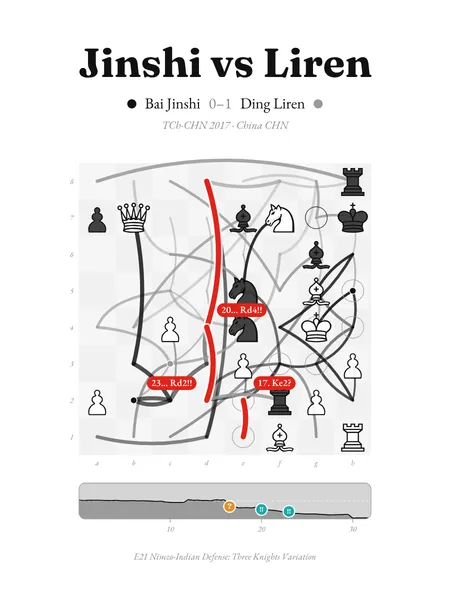
After 15. Nxe5: Black to play, with White's king still in the center
lets White take the queen. After the pawn takes on b2 with check and threatens to queen. Modern analysis rates the sacrifice sound: the position is about equal.
White's best was to give the rook back with , and the game stays level. is the mistake that loses. After Black has given his queen for a rook and a knight, but White's king stands on e2 with no shelter, and modern analysis shows Black winning.
The rook offers
The king has already walked to f3, and Ding brings more pieces.
After 20. Kf3: Black to play the famous 20...Rd4
puts the rook where the e3 pawn can take it, and modern analysis rates it Black's strongest move. Taking loses at once: checks the king and attacks the queen on c2, so the queen is lost next move.
Now Ding offers the rook again, with . It is the only winning move. Other moves, like 23...Ne4+, let White off the hook. If the knight forks the king and the queen, and Black is winning.
The king hunt
White's king has no choice: 26. Kxh5 is its only legal move. It now stands on h5, deep in Black's half of the board.
Black takes the f2 pawn, and his pieces close in on the white king. White grabs pawns and checks, but ends the hunt.
Final position: mate in at most three moves, and White resigned
White's king has only two moves, and , and both lose to mate within three moves: , or . Bai resigned.
What to take from it
A king in the center can be worth a queen. Ding gave up his queen on move 15 because White's king was still on e1. The minor pieces, rooks and pawns that hunted it were worth more than the queen alone.
Offer pieces the opponent can't take. 20...Rd4 and 23...Rd2 both hung a rook, but each capture lost to a knight fork. Before you put a piece en prise, check what happens after it is taken: here a check that also hit the queen.
Bring every piece. By the end the black knights, bishops and rook all stood within a few squares of White's king. A king hunt succeeds when the attackers outnumber the defenders near the king.
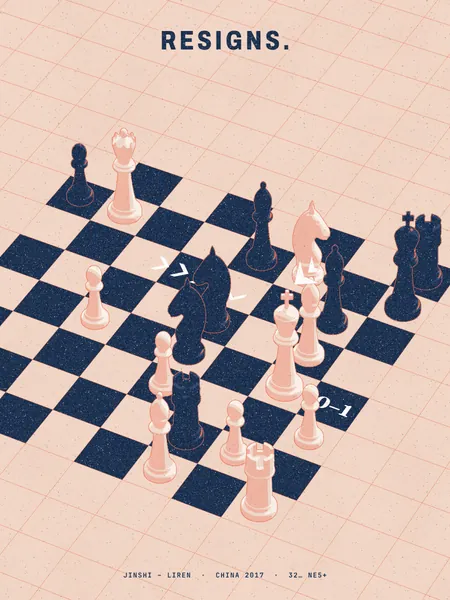
This game as a poster
Made with Posterage, our sister site: pick a style and colors, then print it.
Keep learning
- Queen sacrifices15...dxc3 gives up the queen for a rook, a knight and a king stuck in the center. Learn when the queen is worth less than the attack.
- King huntsWhite's king walks from e1 to h5 under fire from Black's knights, bishops and rooks.
- Nimzo-Indian DefenseThe opening of the game, here with 4. Nf3 and 5. Bg5 for White.
Questions
Was the queen sacrifice sound?
+
Yes. Modern analysis rates the position after 15...dxc3 about equal, about as good for Black as the quieter 15...Qf6. White's real mistake came two moves later. 17. Rd2, giving back the rook, kept the balance. After 17. Ke2 Black is winning.
Why can't White take the rook on d4?
+
After 21. exd4 Nxd4+ the knight checks the king on f3 and attacks the queen on c2 at the same time. White's king has to move, and 22...Nxc2+ wins the queen. Black would be winning easily.
How did the game end?
+
Bai resigned after 32...Ne5+. White has only two moves, and both lose to mate within three moves, for example 33. Nxe5 Bf5+ 34. Kh5 Kg7+ 35. Bh6+ Rxh6#.
The game score is public domain. Notes by Chessage, with every variation checked by a chess engine.