The moves
Click any move to see it on the board, then step through the game with the arrow keys or the buttons under the board.
Who played it and why it's famous
Magnus Carlsen of Norway, world champion since 2013, defended his title against Ian Nepomniachtchi of Russia in Dubai in late 2021. The match was planned for 14 games. The first five were all drawn, and no classical game in a world championship match had been decisive since 2016: 19 draws in a row.
Game 6 was played on December 3. It lasted 136 moves and 7 hours 45 minutes and ended after midnight, the longest game in the history of the world championship. Carlsen won it, took a 3½–2½ lead, and never looked back.
The game is famous for its length and for its last phase. From move 82 Black had a queen against a rook, a knight and three pawns. The ending was a draw, but Black had to defend it accurately for almost 50 moves, deep into the night, while White could press without any risk.
The opening and the middle game
is a Catalan-like setup, with the bishop on g2 aiming down the long diagonal. Carlsen delays c4 to avoid the main lines of the Catalan. After he has the pawn back, and the game is equal.
brings out the rest of the pieces, and after Black has doubled f-pawns but keeps his two bishops. The game is still level.
is the first big decision. After Nepomniachtchi has given two rooks for White's queen. White has two rooks and a knight against a queen and a bishop, and modern analysis still rates the game equal. The material is unbalanced now, and that is what kept the game going for another hundred moves.
After 27...Qd5: two rooks and a knight against a queen and a bishop
The time scramble
Both players were short of time before move 40, and both missed chances. let White in: after the quiet would have left White clearly better. Carlsen played instead, and after Black was slightly better, with a passed a-pawn.
Then it was Black's turn. After Black could take the pawn on b4: the knight on d3 can't recapture, because it shields the rook on d1 from the black queen. would have given Black a clear edge. let White connect his rooks with . At move 40 White missed one more: would have kept White clearly better, and after the game was equal again.
Black gives up the a-pawn
After move 40 both sides regrouped. Then let White take the a-pawn: . Modern analysis still rates the position close to equal, but Black's passed a-pawn was gone, and from then on only White could play for a win. Nepomniachtchi himself called the move "unnecessary" after the game.
gives back the exchange to change the position: , and White has a rook, a knight and three pawns against a queen and a pawn. Modern analysis rates it a draw, but only White has any chance of winning.
The ending: queen against rook, knight and pawns
From here Black's job was to keep the white pawns where they were. For 28 moves Nepomniachtchi did it, while Carlsen moved his king, rook and knight around looking for a way through. With the knight on e2 and the rook on d4 shielding his king, finally starts the pawns moving.
trades Black's last pawn. Now only seven pieces are left: rook, knight and two pawns against a queen. Modern analysis shows the position as a draw with best play, and it stayed a draw for the next 15 moves.
After 130. Kh3: only 130...Qb1 and 130...Qc2 hold the draw
On move 130 Black had two drawing moves, and . Both keep the queen behind the white pawns, where it can harass them and the white king. put the queen in front of the pawns instead, and now White wins by force.
pushes on. The rook on f5 looks loose, but loses the queen to , a fork of king and queen. After the pawns are about to promote, and Nepomniachtchi resigned.
Final position: Black resigned after 136. Ng7
What to take from it
Defending a long ending is a skill of its own. Black held for almost 50 moves and then lost with one move. When you defend, check every move for what it gives up, not only for what it threatens.
Keep your queen behind the pawns. The drawing moves on move 130 kept the black queen where it could stop the e- and f-pawns from behind. After 130...Qe6 the queen stood in front of them, and White's king, knight and rook could escort the pawns forward.
Pressing costs nothing when you can't lose. White's king was safe and his pieces protected each other, so Carlsen could try idea after idea. When you have a position like that, keep asking questions. A tired opponent has to answer every one.
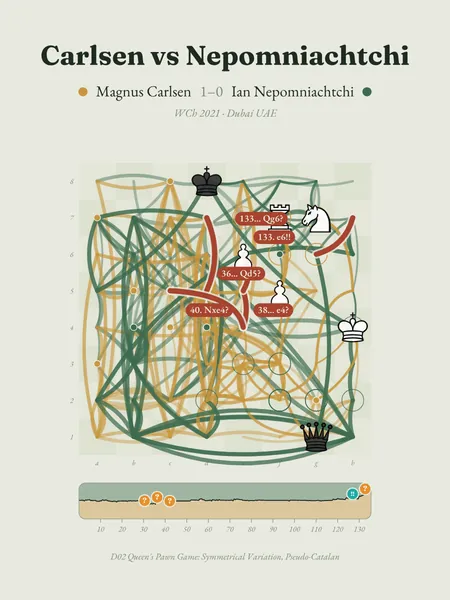
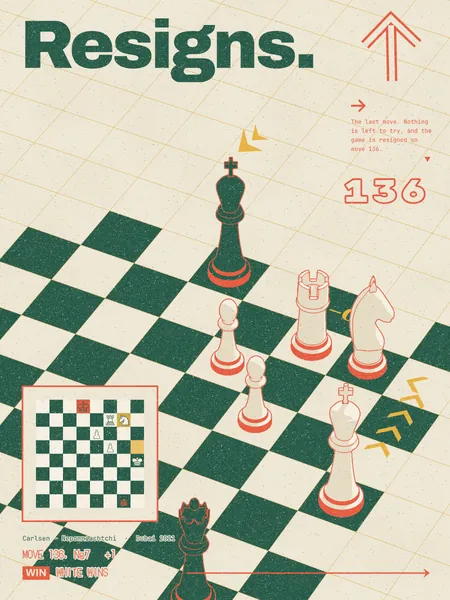
This game as a poster
Made with Posterage, our sister site: pick a style and colors, then print it.
Keep learning
- Ding vs. Gukesh, 2024, Game 14Another world championship game decided by one slip in a long, drawn ending.
- Catalan OpeningCarlsen's setup with g3, Bg2 and c4 is a close relative of the Catalan. Learn the main ideas of the opening.
- ForkIn the final attack, 133. e6 works because taking the rook on f5 runs into a knight fork on g7.
Questions
Was the ending a draw?
+
Yes, for a long time. From 115...Qxh4 only seven pieces were left, and modern analysis shows the position as a draw with best play. But Black had to find the right queen moves again and again, while White could press without any risk. On move 130 only 130...Qb1 and 130...Qc2 held. 130...Qe6 lost.
What was the longest world championship game before this one?
+
Game 5 of the 1978 match between Viktor Korchnoi and Anatoly Karpov, a draw in 124 moves. The longest decisive game before 2021 was game 16 of the 1990 match, which Kasparov won against Karpov in 102 moves.
How did the match end?
+
Carlsen won it 7½ to 3½, with four wins and seven draws, and kept his title. After game 6 Nepomniachtchi lost games 8, 9 and 11, and the match ended after game 11 of the 14 planned.
The game score is public domain. Notes by Chessage, with every variation checked by a chess engine.