The moves
Click any move to see it on the board, then step through the game with the arrow keys or the buttons under the board.
Who played it and why it's famous
The 2006 Corus tournament in Wijk aan Zee, the Netherlands, ran from January 13 to 29. Fourteen players met in group A, and Viswanathan Anand and Veselin Topalov tied for first. Sergey Karjakin, who had turned 16 two days before the first round, was playing group A for the first time. He had qualified by winning group B the year before.
They met in round 1, on January 14. Writing in The New York Times, Robert Byrne called it the most exciting game of the event, with Anand throwing bishops and knights around and finishing with a big attack. Karjakin went on to score 7 points out of 13. Anand finished with 9.
The opening: the English Attack
is the Najdorf Sicilian. is the English Attack: White castles long and throws the kingside pawns at the black king.
and Black throws his pawns back. The kings are castled on opposite sides, so pushing pawns at the other king doesn't weaken your own. The first to break through usually wins.
The race
and both sides are hitting pieces. The f-pawn attacks the bishop on e6, and the a-pawn attacks the knight on b3.
gives the knight up rather than retreat it. After White has a pawn for it, and the knight attacks the bishop on e6 a second time. hits back at once.
is Black's first sacrifice. The bishop was attacked, so instead of retreating it Anand puts it where it opens the a-file. After material is level again, but the a-file is open toward the white king.
and the rook joins the attack. Modern analysis rates White slightly better, but the game is still balanced.
Karjakin's mistake
puts the queen on the c-file. was better and keeps White slightly better. After , with the queen and rook lined up on the a-file, the edge has passed to Black.
After 24. Bg2: Black to play, and Anand finds a winning combination
is the losing mistake. kept the game about equal. Now Anand has a combination.
Two sacrifices: 24...Nc7 and 25...Rc8
offers the knight. It heads for b5, where it would hit the queen on c3 and the knight on a3. Modern analysis rates it Black's best move, and Black is winning.
offers more. The rook hits the white queen, and it has to run. takes the bishop on e7 as it goes. White is a knight and a bishop up, but Black's queen, rooks and knight are all aimed at the white king.
threatens to take on a3 and open the king completely. Karjakin went for his own attack with , and Anand took on a3: . After the king is mated, so , and Black's knights and bishops are all gone. What is left is a queen and two rooks against White's whole army.
The knight promotion
is the right square for the king. promotes to a knight, with check. A queen would lose at once: .
After 32. Qxf8: White has a queen, two rooks and two bishops, Black only a queen and a rook
and White is a rook and two bishops up. It doesn't matter, because the white king has no shelter. starts the hunt.
The king hunt
walks into a mating net. held out longer, though Black is still winning. Now drives the king back and forth, and Karjakin resigned.
Final position: Black mates in at most two moves, on c2 or e2
The queen and rook do it alone. is mate, and so is .
What to take from it
In a pawn race, open a file. When the kings are castled on opposite sides, the side that opens a line first usually wins. 19...Bb3 gave up a bishop to open the a-file, and that file decided the game.
Count the attackers, not the material. By the end Anand was a rook and two bishops down, but the white pieces were far from their king. A queen and rook near the king beat a whole army that can't get back.
Look at every promotion piece. 31. f8=N+ was the only promotion that didn't lose at once, because the knight came with check. When a pawn promotes, check whether a knight does something a queen can't.
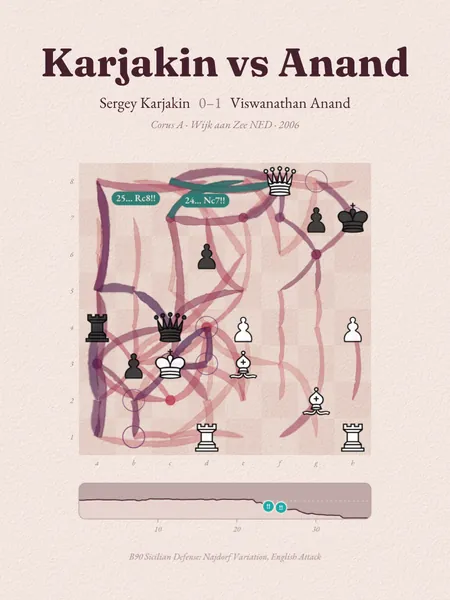
This game as a poster
Made with Posterage, our sister site: pick a style and colors, then print it.

Keep learning
- Najdorf SicilianOur guide to the Najdorf for Black, with the ...e5 and ...Be6 setup Anand used against the English Attack.
- Opposite-side castlingWhite castled long, Black short, and both sides threw their pawns at the other king. Learn how these races are won.
- Anand's ImmortalSeven years later, at the same tournament in Wijk aan Zee, Anand beat Levon Aronian with another attack full of sacrifices.
Questions
Why did Karjakin promote to a knight on move 31?
+
The knight comes with check, and it gains a tempo. 31. f8=Q loses at once to 31...Ra1+ 32. Kb2 Qa2#. After 31. f8=N+ White is still lost, but not mated in two.
Where did Karjakin go wrong?
+
Mainly on move 24. 24. Bg2 let Anand play 24...Nc7, and modern analysis rates Black winning from there. 24. Rg1 kept the game about equal. A move earlier, 23. Qb4 was better than 23. Qc3.
Why did Karjakin resign after 37...Qc4+?
+
White has only two moves, and both are mated: 38. Kb2 Qc2# at once, or 38. Kd2 Ra2+ 39. Ke1 Qe2#.
The game score is public domain. Notes by Chessage, with every variation checked by a chess engine.