The moves
Click any move to see it on the board, then step through the game with the arrow keys or the buttons under the board.
Who played it and why it's famous
Garry Kasparov had been the world's highest-rated player for twenty years when he came to the Linares tournament in Spain in February 2005. Seven players met each other twice, from February 23 to March 10. Before the last round Kasparov led by a point, and his last opponent was Veselin Topalov of Bulgaria, the man in second place. A draw would have won him the tournament outright.
He lost. Topalov's win tied them on 8 points, and Kasparov still took first place on the tiebreak. Then, right after the round, he announced that he was retiring from professional chess. This was the last game he played in a serious tournament.
After the game Kasparov said that once he had won the tournament in his head, "in this final game against Topalov I lost all my sense of danger." The game is short, and it is a lesson in how a draw can slip away in an ending that looks simple.
The opening: a Sicilian Defense
is the Sicilian Defense, Kasparov's main defense against 1. e4. After Topalov chose a quiet setup with the bishop on c4. Black's pawns on c5 and e5 give his knight a strong square on d4, and goes straight there.
and show White's plan: open the f-file for his rook. After the file is open, but Black's king steps to d7 and the black rook comes to f8 to challenge it. Modern analysis rates Black slightly better here.
The trades
leaves each side with a queen, a rook and a knight. White is a pawn up, but Black's queen and rook are active, and the game is equal.
After 21. Qf1: Kasparov can keep the queens on, or trade everything
offers a trade of queens on the f-file. With the pieces on, the game was equal. and both keep the game equal in modern analysis, and 21...Qd8 was the move most spectators expected.
Instead he traded everything. reaches a king and pawn ending in three moves. The commentators in the press room first gave 21...Qxf1+ two question marks, then took the marks away after looking at it with Topalov. Modern analysis takes the first view: the ending is very bad for Black.
The pawn ending
Why is it bad? White's extra pawn is a doubled one, on d3, and that is why the ending looked harmless. But with no pieces left every pawn counts, and the three white pawns on d3, d4 and e4 hold the center. Modern analysis rates White close to winning already.
and White is winning. or would have kept the win.
After 27. h4: Black has one move that keeps him in the game
lets Black back in. is the only move that keeps Black in the game. Modern analysis rates White only slightly better after it, against a winning position after every other move. Ljubomir Ljubojevic, analyzing in the press room, said that it led to a draw.
was the decisive mistake. After it modern analysis shows White winning again, and after the white king is ready to go forward. Kasparov resigned.
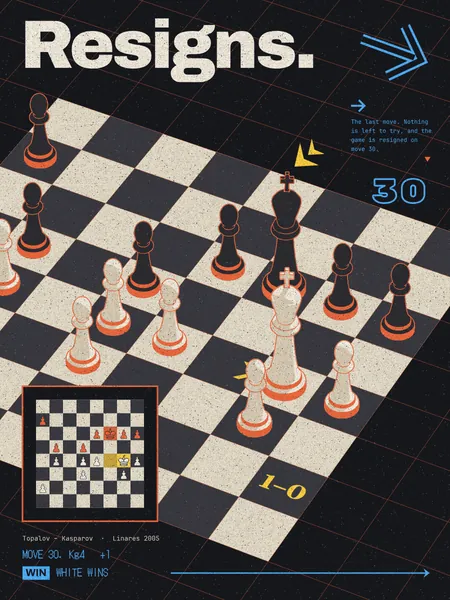
Final position: Kasparov resigned after 30. Kg4
What to take from it
Count before you trade into a pawn ending. With pieces on, 21...Qd8 was equal. After the trades nothing could be repaired. A pawn ending is the one ending where you can calculate everything, so do it before you go in, not after.
Every pawn move is permanent. 27...h6 held and 27...g6 lost. In a pawn ending, ask which squares a pawn move gives away for the enemy king. You can't move it back.
A draw is not a result until it's on the scoresheet. Kasparov needed half a point. He said himself that he lost his sense of danger once he felt the tournament was won.
This game as a poster
Made with Posterage, our sister site: pick a style and colors, then print it.
Keep learning
- Linares 2005The tournament this game decided, with the final standings. Kasparov and Topalov finished on 8 points each.
- Kasparov's ImmortalThe same two players at Wijk aan Zee six years earlier, when Kasparov won one of the most famous attacking games ever played.
- Key squaresPawn endings are won by the king that reaches the right squares first. Learn the idea behind the last moves of this game.
- Sicilian DefenseKasparov's lifelong answer to 1. e4. Learn the main ideas of the opening he chose for his last game.
Questions
Was this really Kasparov's last game?
+
It was his last game in a serious tournament. He announced his retirement from professional chess right after it, on March 10, 2005. Since then he has played rapid and blitz events and exhibition matches.
Why did Kasparov still win Linares?
+
Topalov's win tied them on 8 points out of 12, with the same number of wins. Linares broke the tie by the number of wins with Black. Kasparov had three, Topalov one, so Kasparov took first place, his ninth Linares title.
Was the pawn ending lost from the start?
+
Modern analysis rates it as very bad for Black, and White was winning after 26...Kf6. But 27. h4 gave Black a chance. After 27...h6 White is only slightly better, and in the press room Ljubomir Ljubojevic said it was a draw. After 27...g6 Black was lost again.
The game score is public domain. Notes by Chessage, with every variation checked by a chess engine.