The moves
Click any move to see it on the board, then step through the game with the arrow keys or the buttons under the board.
Who played it and why it's famous
In September 2002 Russia played a team of the Rest of the World in Moscow, a match billed as the "Match of the 21st Century". Two teams of ten played a ten-round match at a rapid time control, 25 minutes plus 10 seconds a move. Kasparov, the world's top-rated player, played for Russia, and Judit Polgár for the World.
They met in round 5, on September 9. Polgár had never beaten Kasparov before. This time she did, and it was the first time a woman had beaten the world's No. 1 player in competitive play. The World team won the match 52–48.
The opening: a Berlin Defense
is the Berlin Defense of the Ruy Lopez. Two years earlier Vladimir Kramnik had used it as Black against Kasparov in their world championship match. Kasparov never found a way through it, and Kramnik took his title. Here Kasparov chose it himself, instead of his usual Sicilian.
After the queens are gone and Black's king can no longer castle. In return Black has the two bishops. Modern analysis rates the position about equal, but it asks Black for patience, and the king in the center can become a target.
White takes space
White's plan is to keep the pawn on e5, which cramps Black, and to push her kingside pawns. is a small slip. Modern analysis prefers , keeping the bishop flexible. After the pawn takes the f5 square away from the bishop, and White is clearly better.
puts a knight on f5, where it blocks the bishop on h7. lets White's advantage grow. Modern analysis prefers , hitting White's center at once.
After 19...Bg6: Black's king is still on e8, and the knight on f5 dominates
The center opens against the king
Black gets rid of the knight on f5 and wins a pawn, but the e-file is half open now, and Black's king still stands on it, behind the pawn on e5.
lines up the rook with the black king before taking the pawn. It is much stronger than taking at once: after Black trades rooks on the d-file, and White is only slightly better. In the game, after White has won the pawn back, and Black's d6 pawn is weak.
Rooks on the seventh
White wins the d6 pawn and is a pawn up. Kasparov's rooks give checks from behind, , but the white king walks up to e4 and the checks run out.
puts both white rooks on the seventh rank, where they attack Black's pawns from the side and hem in the king. wins back the f5 pawn, but takes the g7 pawn instead.
Final position: two rooks on the seventh, and a7 falls next; Kasparov resigned
White is a pawn up, and 43. Rxa7 is coming. Modern analysis shows White winning, and Kasparov resigned. He left the hall at once, through a passageway closed to journalists and photographers.
What to take from it
A king in the center is a target, even without queens. Black's king never found a safe square. Once the e-file and d-file opened, White's rooks had it to aim at.
Line up before you take. 26. Re1 brought the rook to the king's file first and won the e5 pawn a move later, on better terms. When a pawn can't run away, improve a piece before capturing it.
Two rooks on the seventh rank win endgames. From b7 and g7 White's rooks swept Black's second rank, took the g7 pawn, aimed at a7 and kept the king boxed in on the back rank.
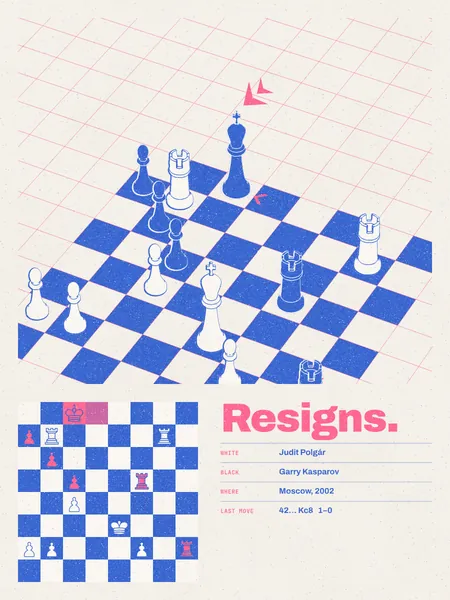
This game as a poster
Made with Posterage, our sister site: pick a style and colors, then print it.
Keep learning
- Ruy Lopez, Berlin DefenseThe opening of the game. After 4...Nxe4 and the early queen trade, Black's king stays in the center for good.
- Open files and the seventh rankWhite's rooks used the d-file and the e-file to reach the sixth and seventh ranks. Learn how rooks win games this way.
- Polgár vs. Kasparov, 1994Their game eight years earlier, remembered for a touch-move dispute.
Questions
Why is this game famous?
+
It was the first time in chess history that a woman beat the world's No. 1 player in competitive play. Kasparov was the world's top-rated player, and Polgár had not beaten him before.
Was it a classical game?
+
No. The match was played at a rapid time control, 25 minutes per player with 10 seconds added for each move.
Where did Kasparov go wrong?
+
There was no single blunder. Modern analysis points to 15...Bh7, which let White's pawns and knight shut the bishop out, and to 19...Bg6, after which White was clearly better. From there Polgár kept improving her pieces until her rooks reached the seventh rank.
The game score is public domain. Notes by Chessage, with every variation checked by a chess engine.