The moves
Click any move to see it on the board, then step through the game with the arrow keys or the buttons under the board.
Who played it and why it's famous
Linares 1994 was the first time the 17-year-old Judit Polgár was invited to play against the world's strongest players. After four rounds she had two points. In round 5 she had White against the world champion, Garry Kasparov.
The game is famous for one moment on move 36, when Kasparov was accused of breaking the touch-move rule. Under that rule a player who touches a piece must move it, and once the hand leaves the piece on its new square, the move stands. Kasparov won the game, but the dispute is the reason it is remembered.
The opening: a Sicilian Defense
is the Najdorf move order of the Sicilian Defense, and turns it into a Scheveningen setup: Black's pawns on d6 and e6 guard the center, and his pieces wait behind them.
White castles, brings her queen to e1 and then g3, and pushes . Now d5 is a hole in Black's camp, a square no black pawn can guard, and a fine post for a white knight. For the next ten moves both sides maneuver, and modern analysis rates the game equal after .
The mistake: 27. Be2
After 26...Qb4: Black's queen and bishop eye the pawn on e4
moves the bishop that guarded e4. Modern analysis prefers , keeping the game level. Kasparov at once takes the pawn: , and Black is a pawn up and clearly better.
Polgár wins the a6 pawn back with , but Black's pieces are more active. After Black's rook sits on White's second rank, and modern analysis rates Black clearly better.
The touch-move dispute
After 36. Nd2: Kasparov to play, the knight on d7 the piece in question
According to the reports, Kasparov picked up his knight on d7 and put it on c5. Seeing that would be bad for him, he moved it again, to f8. Polgár believed his hand had left the knight on c5, in which case the move should have stood. Kasparov said he was not aware of his hand leaving the piece.
Here is why c5 was a bad square. On c5 the knight blocks the c-file, so the rook on c2 no longer guards c6. White's bishop on b7 could go to c6 and attack both the queen on a4 and the rook on e8, and White wins the exchange. Modern analysis shows the position after 37. Bc6 about equal, so 36...Nc5 would have thrown away Black's advantage.
On f8 the knight stays off the c-file. After the same idea fails: and the rook simply takes the bishop. Even so, 36...Nf8 was not Black's best move. Modern analysis prefers , and after the game move Black is only slightly better.
How Kasparov won
handed Black a clear advantage again. Modern analysis prefers , after which Black is only slightly better. After Black's knight and rook both hit f2, and made it worse: was the way to defend. was now stronger, winning the exchange. Kasparov played instead, which kept Black clearly better.
The pawn on e3 is two squares from queening, and Black's queen and knight are aimed at White's king. After Polgár resigned. Modern analysis shows Black winning by force.
Final position: the e-pawn runs, and Polgár resigned
After the game
Spanish television had filmed the game, and the footage was reported to show Kasparov's fingers leaving the knight. The tournament director did not forfeit Kasparov, and the video was not released publicly. Polgár went into a slump for the next six rounds, and the two players did not speak for three years. Later they became friends, and Kasparov invited her to one of his training camps.
What to take from it
Check what a piece was guarding before you move it. 27. Be2 gave up the guard on e4, and 36...Nc5 would have cut the rook off from c6. Before a move, ask which squares the piece stops guarding, and which lines it blocks.
A fork needs a square nobody guards. 37. Bc6 hit the queen and the rook, but it only worked if the rook on c2 could not take the bishop. Look at who guards the fork square, not just at what the fork hits.
Short of time, the defense breaks first. The mistakes 38. Nxf6+ and 40. Rf1 came in the time pressure Polgár later described. When the clock is short, choose the safe defensive move over the active one.
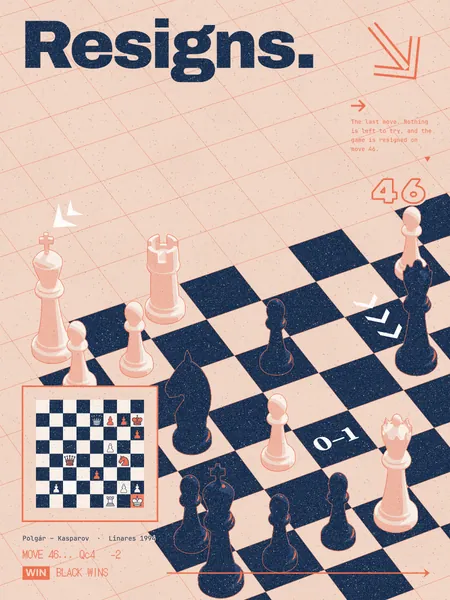
This game as a poster
Made with Posterage, our sister site: pick a style and colors, then print it.
Keep learning
- Polgár vs. Kasparov, 2002Eight years later Polgár beat Kasparov for the first time, in a rapid game in Moscow.
- Sicilian DefenseKasparov's usual answer to 1. e4. This game reached a Scheveningen setup, with pawns on d6 and e6.
- ForkThe move Kasparov avoided, 37. Bc6, would have hit his queen and a rook at once.
Questions
Did Kasparov break the touch-move rule?
+
The accounts differ. Polgár was sure he had let go of the knight on c5, and Spanish television footage was reported to show his fingers leaving it for a fraction of a second. The arbiter saw the incident and took no action. Kasparov said his conscience was clear, as he was not aware of his hand leaving the piece.
Would 36...Nc5 have lost the game?
+
No, but it would have thrown away Black's advantage. After 37. Bc6 White wins the exchange, and modern analysis rates the position about equal. After 36...Nf8 Black stayed better.
Why didn't Polgár claim the move?
+
She later said she didn't want to cause unpleasantness at her first invitation to such an important event, and that she feared a clock penalty if her claim was turned down while both players were short of time.
The game score is public domain. Notes by Chessage, with every variation checked by a chess engine.