The moves
Click any move to see it on the board, then step through the game with the arrow keys or the buttons under the board.
Who played it and why it's famous
Anatoly Karpov, then the FIDE world champion, met the 18-year-old Veselin Topalov in round 4 of the Linares tournament in Spain, on February 27, 1994. The field was the strongest ever assembled at the time, with an average rating of 2685. Karpov won it undefeated with 11 points out of 13, two and a half points ahead of Garry Kasparov and Alexei Shirov.
Karpov's style was positional: small advantages, minimal risk, slow pressure. That is why this game stands out. To break open Black's king he gives up a rook on g6 and a second rook on d4, and the game is known as Karpov's Immortal.
The opening: a Symmetrical English
started as a queen's pawn game but reached a Symmetrical English, the line of the English Opening where both sides play c-pawns early. White's bishop on g2 aims down the long diagonal at the queenside.
gives Black the two bishops, but White gets an open e-file for his rook and a target on d6. After White starts a pawn storm with , and the h-file is open.
The deflection: 18. Nc5
After 17...hxg6: the d6 pawn shields the bishop on d7 from White's queen
White's queen on d2 and Black's bishop on d7 stand on the same file, with only the pawn on d6 between them. attacks the bishop and offers the knight to that pawn. Modern analysis rates it White's strongest move, and White is clearly better.
takes the bait, and wins the bishop back. Material is level, but Black's center is gone, and the knight on c6 and the pawn on e6 are loose. Black could have limited the damage with , keeping the d-file closed. After the game move White is winning.
The first rook: 21. Rxg6+
defends the knight on c6, and now offers the first rook. It is the only strong move: the quiet leaves White barely better. Taking the rook is even worse: after White has won back a knight and two pawns, the rook on a8 is attacked, and modern analysis shows White winning easily.
Topalov tries , attacking the queen along the seventh rank. Karpov answers with a second rook offer, . This time Black has to take: loses even faster. After White has given a rook for a knight and two pawns. The material count is level again, but Black's king stands on g7 with a single pawn in front of it, and modern analysis shows White winning.
The second rook: 28. Rxd4
Black's bishop has reached d4, where it guards e5 and f6, the dark squares the white queen wants.
After 27...Qxa6: the bishop on d4 guards the dark squares near Black's king
gives up the second rook for that bishop. This is an exchange sacrifice, a rook for a minor piece, and modern analysis rates it the strongest move by far. After the queen is in, and with the knight and bishop she chases the king: .
wins the knight, but the queen raid has swept the board. After White has a queen, a bishop and five pawns against a queen and a rook with no pawns, and Topalov resigned.
Final position: Black has no pawns left, and resigned
What to take from it
Open lines before you sacrifice. Karpov's h4, h5 and hxg6 opened the h-file first. The rook sacrifices only worked because Black's king had already lost its pawn cover.
Look at what a pawn is shielding. The d6 pawn was all that stood between White's queen and the bishop on d7. 18. Nc5 deflected it, and the d-file opened with gain.
Give a rook for the key defender. The bishop on d4 held Black's dark squares together. Removing it with 28. Rxd4 let the white queen in, and the attack ran by itself.
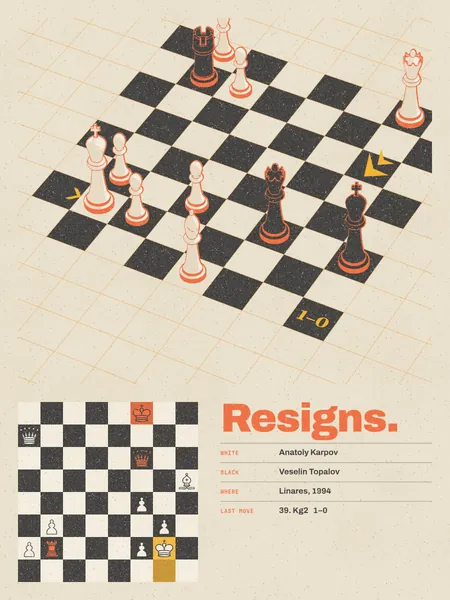
This game as a poster
Made with Posterage, our sister site: pick a style and colors, then print it.
Keep learning
- Deflection18. Nc5 deflects the d6 pawn, which was shielding the bishop on d7 from White's queen.
- Rook sacrificesKarpov gives up a rook twice, once to open the king and once to remove its best defender. Learn when a rook is worth less than an open king.
- Kasparov's ImmortalFive years later Topalov was on the losing side of another famous sacrificial attack, this time against Kasparov.
Questions
Why is this game called Karpov's Immortal?
+
Karpov's style was solidly positional, so a win built on two rook sacrifices stood out. His win over Topalov is considered possibly the finest of his career, and it came in his best tournament, Linares 1994, which he won by 2½ points.
Did Topalov have to take the knight on c5?
+
No. After 18. Nc5 modern analysis prefers 18...Qa7 19. Nxd7 Qxd7, giving up the bishop for the knight. White stays clearly better, but the d-file stays closed. After 18...dxc5 19. Qxd7 White is winning.
How strong was Linares 1994?
+
Its average rating of 2685 was the highest of any tournament up to then, with Kasparov, Shirov, Kramnik, Anand and Ivanchuk in the field. Karpov scored 11 out of 13 without a loss, and the statistician Jeff Sonas called it the best tournament result in history.
The game score is public domain. Notes by Chessage, with every variation checked by a chess engine.