The moves
Click any move to see it on the board, then step through the game with the arrow keys or the buttons under the board.
Who played it and why it's famous
The second Piatigorsky Cup was played at the Miramar Hotel in Santa Monica, California, from July 17 to August 15, 1966. Ten grandmasters played a double round-robin, every player meeting every other player twice. The field included the world champion Tigran Petrosian, who had kept his title against Boris Spassky that spring, along with Spassky, Bobby Fischer and Bent Larsen.
Petrosian came into round 7 out of form, with 2½ points from six games. Larsen had beaten Fischer and Miguel Najdorf in the two rounds before. This game was played on July 27, and Petrosian resigned on move 30.
Petrosian was famous as a master of defense. Here he is caught by a queen sacrifice that leaves his king with no defense at all. Spassky won the tournament, Fischer was second and Larsen third. Petrosian finished sixth.
The opening: an Accelerated Dragon
is the Accelerated Dragon. Black puts the bishop on g7 before playing ...d6. sets up the Maroczy Bind: pawns on c4 and e4 that grip the d5 square.
is Black's trick against this setup. The knight hits the bishop on e3, and after it lands in the center, eyeing c2. and both sides have castled. White has more space and is slightly better.
The middle game
was a slow move. Modern analysis prefers , hitting e4 at once, with the game close to equal. Now is White's best move: the f-pawn heads for g6 to open lines at the black king, and White is clearly better.
let some of that slip. was stronger, keeping the black knight out of c5, and modern analysis rates White much better after it. After White's edge is almost gone. , trading the knight off, kept more.
The pawn sacrifice: 20. e5
offers a pawn. It attacks d6 and invites Black's bishop to take it, which means leaving g7, the square that guards the king. White could win Black's queen instead, but gives Black a rook and a bishop for it. The attack is gone, and modern analysis rates Black at least equal.
and the queen heads for h6 and h7. keeps the balance, and so does , bringing the last rook toward h3. Modern analysis rates the position about equal. Black needs room for his king, and he needs it now.
The mistake: 23...Bf6
After 23. Rf3: Black must give his king room, and only 23...f5 does it
was the move. The pawn leaves f7, so the king can step there out of danger, and modern analysis rates the game equal.
Petrosian played , and it wastes the move Black needed. After the bishop has to go back to g7 to guard the king, the king still has no room, and White is winning.
The queen sacrifice: 25. Qxg6
After 25. Qxg6: the queen stands where the f7 pawn can take it
is the famous move, and modern analysis rates it the strongest. The queen stands where the f7 pawn can take it, and it threatens to take on g7. Every answer loses.
If Black ignores the queen, the queen takes on g7 and the rooks mate: . If Black takes the queen, and White's two bishops and rooks are all aimed at the king. Modern analysis rates White winning.
is the best defense. The knight blocks the f-file and attacks the queen, so after Black has the queen for a knight. But leaves White a pair of rooks and bishops against a queen, rook and bishop, and the black queen and the rook on a8 have nothing to do.
The finish
swings the second rook toward the king, and heads for h3. Petrosian resigned.
Final position: Petrosian resigned, with the white rooks closing in on h3 and h7
White threatens 31. Rh3+, with mate in four moves. The best Black has is , giving up the queen for a rook, and modern analysis rates White winning easily.
What to take from it
Your king needs a square to run to. After 23...Bf6 the black king still had no room, and every check came close to mate. 23...f5, giving the king f7, kept the game level. When the attack comes, look for an escape square first.
A pawn sacrifice can pull a defender away. 20. e5 gave up a pawn to tempt Black's bishop off g7. Five moves later that square was the one the attack broke through.
Count what each sacrifice opens. 25. Qxg6 gave up the queen, but every answer opened a file or a diagonal to the black king. When you look at a sacrifice, ask what lines open, not only what you lose.
This game as a poster
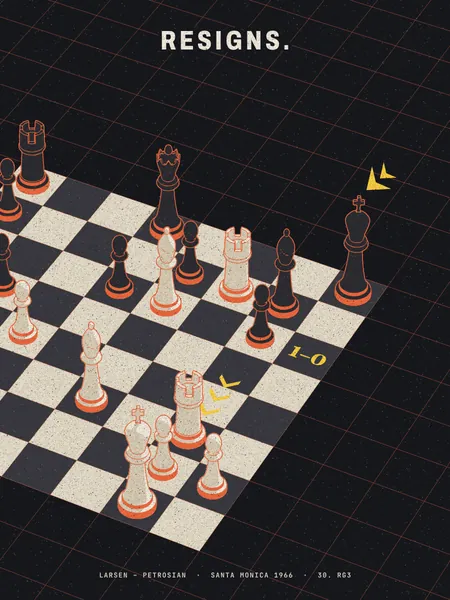
Made with Posterage, our sister site: pick a style and colors, then print it.
Keep learning
- Queen sacrifices25. Qxg6 gives up the queen to open the black king. Learn when the strongest piece is worth giving away.
- Accelerated DragonOur guide to the Sicilian setup Petrosian chose, with ...g6 and ...Bg7 before ...d6.
- Larsen vs. Spassky, 1970Four years later Larsen was on the other side of a famous attack, losing in 17 moves to Spassky in Belgrade.
Questions
Why couldn't Petrosian take the queen?
+
After 25...fxg6 26. Bxe6+ Kh7 27. Rh3+ Bh6 28. Bxh6, White threatens mate with the bishops and rooks, and modern analysis rates White winning. Petrosian's 25...Nf4 at least won the queen back, but White still came out with a winning attack.
Where did Petrosian go wrong?
+
On move 23. 23...f5, which lets the king step to f7, keeps the game about equal. 23...Bf6 lost a move: after 24. Qh6 the bishop had to go back to g7, and modern analysis rates White winning.
Did Larsen beat Petrosian twice at Santa Monica?
+
Yes. The Piatigorsky Cup was a double round-robin, and Larsen won both their games, the second with Black. Larsen later wrote that he was prouder of that second win than of this queen sacrifice. He finished third with 10 points out of 18, behind Spassky and Fischer.
The game score is public domain. Notes by Chessage, with every variation checked by a chess engine.