The moves
Click any move to see it on the board, then step through the game with the arrow keys or the buttons under the board.
Who played it and why it's famous
Tigran Petrosian became world champion in 1963. In 1966 he defended the title against Boris Spassky in Moscow, in a match of 24 games played from April 9 to June 9. The first six games were drawn. Petrosian won game 7 with Black, and after two more draws he led 5–4 before this game, played on May 2.
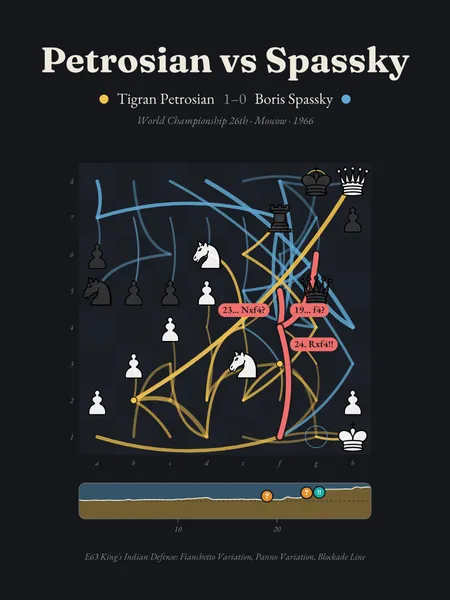
Petrosian was famous for his defense, and for giving up a rook for a minor piece to stop the opponent's play. Here he uses the same exchange sacrifice to attack. He gives up the exchange twice, takes over the dark squares around Black's king, and ends the game with a queen sacrifice. The win put him 6–4 ahead, and he kept his title by one point.
The opening: a King's Indian with ...Nc6 and ...a6
is a King's Indian Defense against White's fianchetto, with Black's knight on c6 and his pawn on a6. Black plans ...Rb8 and ...b5. After the knight on a5 is out of play, and it stays there for the rest of the game.
gives Black a big pawn center on the kingside, but it also opens his king. trades the dark-squared bishops. Now White's queen eyes the long diagonal to h8, and Black has no bishop left to guard it.
The first exchange
is a mistake. Black wants to open the f-file, but modern analysis prefers a quieter move such as , with White only slightly better. After 19...f4, White's strongest was , which leaves him clearly better. Petrosian plays , and White is still slightly better.
is the first exchange: Black takes the rook on f1 for his bishop. Modern analysis rates as more accurate, with the game about equal. After 22. Rxf1 White is better despite the missing exchange. Black's king is open, his knight on a5 is far away, and the pawn on d5 cramps him.
After 22. Rxf1: White is an exchange down, but better
The second exchange
grabs a pawn and walks into the attack. was more stubborn. Now gives up the second exchange. After White's bishop pins the rook on f7 to the king, and modern analysis rates White winning. was even stronger, but 24. Rxf4 wins too.
After 25...Rf7: the rook on f7 is pinned, and the knights head for d6 and f5
brings both knights close to the black king. The one on d6 hits f7, and the one on e3 can jump to f5. adds a defender to f7, but White is winning whatever Black plays. wins back some material. Modern analysis prefers , but both moves win.
The finish
and Spassky resigned.
Final position: after 30...Kxh8 31. Nxf7+ the knight forks king and queen
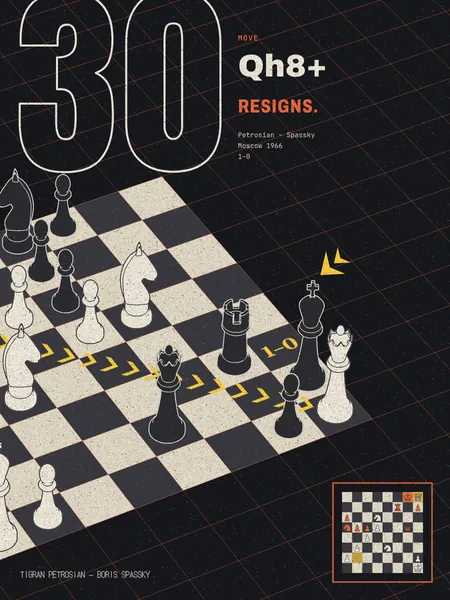
Black's only legal move is to take the queen, and then the knight forks king and queen: . White is a piece up in the ending and winning. Modern analysis shows 30. Qh8+ as the only move that keeps a winning position: after quieter moves such as 30. Nxf7, White is only better.
What to take from it
The exchange is worth giving for the right squares. Petrosian was a rook against a minor piece down after the first exchange, but his knights, bishop and queen were all active, and Black's knight on a5 never got back. Count the pieces that take part in the fight.
Trade off the defender of the long diagonal. After 17...Bxb2 18. Qxb2 Black had no dark-squared bishop, and the squares f6, g7 and h8 were weak for the rest of the game. The final blow, Qh8+, landed on that diagonal.
Look for a queen sacrifice that wins the queen back. 30. Qh8+ works because the knight fork gets the queen back with interest. When your queen can check next to the king, check what your knights can fork after the capture.
This game as a poster
Made with Posterage, our sister site: pick a style and colors, then print it.
Keep learning
Questions
Why did Spassky resign after 30. Qh8+?
+
Black's only legal move is 30...Kxh8, and then 31. Nxf7+ forks the king and the queen on g5. After 32. Nxg5 White is a piece up with a winning ending.
Were Petrosian's exchange sacrifices sound?
+
Yes. The first came when Petrosian's 21. Ne3 let Black take the rook on f1, and modern analysis rates White better afterward because his pieces were far more active than Black's. The second, 24. Rxf4, came when White was already winning, and it kept the win.
How did the match end?
+
Petrosian won 12½–11½ and kept the world title. This win put him two points up, 6–4. Spassky won his first game of the match only in game 13, and he took the title from Petrosian three years later, in 1969.
The game score is public domain. Notes by Chessage, with every variation checked by a chess engine.