The moves
Click any move to see it on the board, then step through the game with the arrow keys or the buttons under the board.
Who played it and why it's famous
Mikhail Tal had been world champion in 1960 and 1961. In 1965 he played Bent Larsen of Denmark in a Candidates semifinal match at Bled, in Yugoslavia. After nine games the score was 4½–4½. The tenth and last game, played on August 8, 1965, would decide who went on to the Candidates final.
Tal won it with a knight sacrifice in the center, , that gave him one pawn and a wide-open e-file for the piece. It is remembered as a speculative sacrifice: Tal gave up a piece for pressure, not for a forced win. Tal took the match 5½–4½ and lost the final to Boris Spassky. Larsen beat Efim Geller in a playoff for third place.
The opening: a Scheveningen
is a Sicilian Defense with Black's pawns on e6 and d6, the Scheveningen setup. After the kings are on opposite sides. That means a race: each side throws its pawns at the other king.
and both storms are under way. hits the knight on c3. Modern analysis rates White slightly better.
The sacrifice
After 16. Nd5: the knight offers itself instead of retreating
The knight is attacked, and the calm retreat keeps White slightly better. Tal played instead.
Black has to take. is the only good move. Anything else leaves White much better, with Nxe7+ or Bxg7 coming. After White has one pawn for the knight. In return the e-file is open toward the bishop on e7, the pawns on d5 and f4 take the e6 and e5 squares from Black's pieces, and Black's queen and bishop on b8 and c8 are far from the kingside.
Modern analysis says Black is better here. After , keeping the kingside pawns together, Black stays a piece up and better.
Where Larsen went wrong
looks active, but it opens lines near Black's own king, and the game is level again. Then puts a rook on the open file.
After 18. Rde1: Black has one good defense here
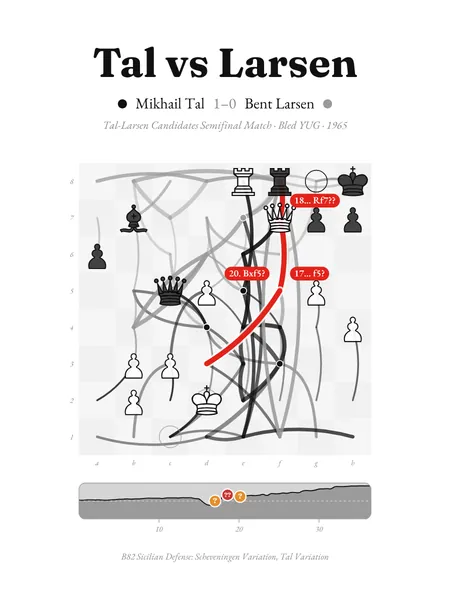
is the decisive mistake. It guards the bishop on e7, but it leaves the bishop on the open e-file. was the move: the bishop steps off the e-file, and Black stays slightly better. After Rf7, modern analysis shows White winning.
is the only strong move, getting the h-pawn ready to join the attack. takes the pawn and removes a defender. Modern analysis prefers , but White is still clearly better after Tal's move. wins the piece back, and now the white rook is on the seventh rank.
Winning the material back
hits the queen, and attacks the rook on e7. Every White reply has to be exact, and Tal's are. and White has an extra pawn and the safer king. 22. Qe4, 23. fxe5 and 24. Qe3 were each the only move that kept White winning.
After White is two pawns up. is the strongest move, and it sets a trap: if , then wins. After White wins the queen, and is mate.
The finish
and the white king is safe. 33. c3 was the strongest way to meet the check.
After 34. Bc5: the bishop pulls the queen off d6
is the strongest move. The bishop offers itself to drag the black queen off the d6 square. After Larsen resigned.
Final position: Black resigned, about to lose the queen for a rook
White threatens Qxf8+ and mate. Black's best is , and White is a queen up against a rook.
What to take from it
A sacrifice can buy lines, not mate. 16. Nd5 won no material back for a long time. It bought an open e-file, two strong pawns and Black's pieces stuck on the queenside. At the board that was worth a knight, even if modern analysis disagrees.
When you're up a piece, defend first. Larsen's 17...f5 and 18...Rf7 were active moves in a position that needed calm ones. 17...g6 or 18...Bd8 kept the extra piece safe.
Look for decoys at the end. 34. Bc5 offered a bishop just to pull the queen off d6. After that, Re8+ and Qe6+ came with check, and Qf7 won the queen for a rook.
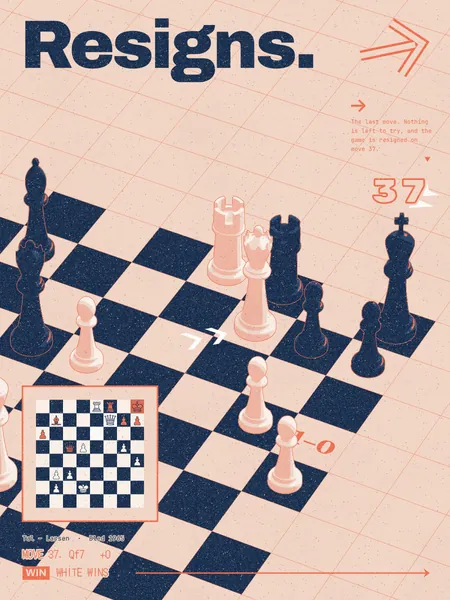
This game as a poster
Made with Posterage, our sister site: pick a style and colors, then print it.
Keep learning
- Sicilian DefenseOur guide to 1. e4 c5. This game is a Scheveningen, with Black's pawns on e6 and d6.
- Decoy34. Bc5 offers a bishop to lure the black queen off d6. Learn how decoys set up the finish.
- Larsen vs. Spassky, 1970Five years later, Larsen lost a 17-move game to the world champion on board 1 in Belgrade.
Questions
Was 16. Nd5 a sound sacrifice?
+
Not by modern analysis. With 17...g6 or, a move later, 18...Bd8, Black keeps the extra piece and stands better. 16. Ne2 would have kept White slightly better. But the defense was hard to find at the board, and Larsen missed it.
Why did Larsen resign after 37. Qf7?
+
White threatens Qxf8+ and mate. Black's best is 37...Qxd5+ 38. Qxd5 Rxe8 39. Qxb7, and White is a queen up against a rook.
What was at stake?
+
The match was level at 4½–4½ before this last game. Tal's win took the match 5½–4½ and put him in the Candidates final, which he lost to Boris Spassky later in 1965.
The game score is public domain. Notes by Chessage, with every variation checked by a chess engine.