The moves
Click any move to see it on the board, then step through the game with the arrow keys or the buttons under the board.
Who played it and why it's famous
The 27th USSR Championship was played in Leningrad from January 26 to February 27, 1960, with 20 players. Boris Spassky beat David Bronstein in round 16. Spassky finished only 10th, but this game became famous.
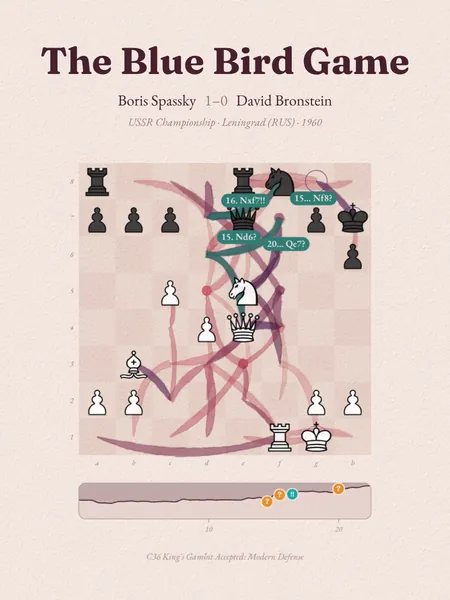
It is famous for a race. Black's pawn runs from f4 to e2 and queens on f1 with check, and Spassky lets it, because his knight is already on its way to f7. The chess game at the start of the James Bond film From Russia with Love reenacts a version of the finish.
The opening: a King's Gambit
is the King's Gambit, and accepts the pawn. is the Modern Defense to the King's Gambit Accepted: Black strikes in the center at once. After both sides have castled, and material is level: Black's pawn on f4 against White's on d5.
attacks the queen and the rook on f1, and gives Black a pawn on e3, deep in White's position. lines up the queen and bishop behind the knight on e4, aimed at h7.
The race
pushes the pawn to e2, where it attacks the rook on f1. Modern analysis prefers . After 14...e2 White can simply take the pawn with , and he would be clearly better.
After 14...e2: the pawn attacks the rook, and Spassky ignores it
Spassky played . The knight attacks the rook on e8 and the pawn on f7, and the queen and bishop are aimed at h7. It isn't the strongest move, but it sets Black a hard problem. The calm answer was , and modern analysis rates the game equal.
brings the knight back to guard h7, and it loses. Now is White's only good move, and it is a strong one. The knight on f7 attacks the queen on d8 and the pawn on h6. It can't be taken: after White mates in a few moves.
lets Black queen, and the new queen lasts one move. White is a rook down for a pawn, but the knight on f7 and the queen and bishop on the b1–h7 diagonal are aimed at the black king. Modern analysis rates White clearly better.
After 17. Rxf1: Black's new queen is gone, and the knight on f7 hits d8 and h6
The finish
tries to block the diagonal and loses the bishop to . Modern analysis prefers . After White is winning. makes it quicker, and modern analysis prefers .
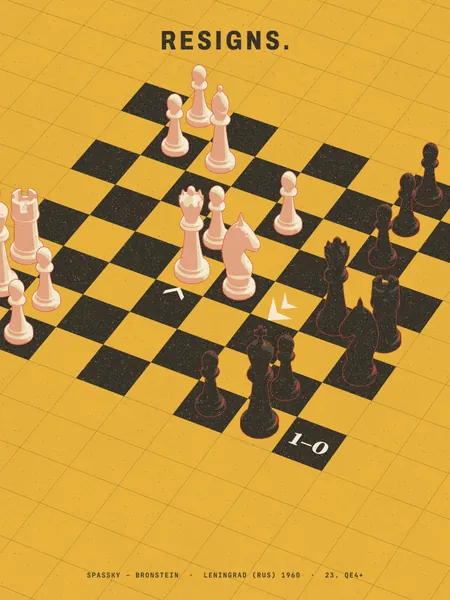
puts the bishop on the diagonal toward g8. After the knight moves off f7 with a discovered check from the bishop, and checks again. Bronstein resigned.
Final position: Bronstein resigned after 23. Qe4+
Black has three answers to the check, and two of them lose at once. is mate, and loses to . Only keeps the game going, and after White is winning easily.
What to take from it
A dangerous threat isn't always the most important one. Black's pawn on e2 was about to queen with check, but Spassky's knights reached f7 first. Before you stop a threat, ask whether your own attack is faster.
Answer a bold move calmly. 15. Nd6 was not White's best, and 15...Bxd6 held the balance. Bronstein's 15...Nf8 looked solid, but it let the knight jump to f7.
Watch the f7 square. It is the weakest point in Black's position. Here 16. Nxf7 broke it open, and the f-file and the b3–g8 diagonal stayed open to the end.
This game as a poster
Made with Posterage, our sister site: pick a style and colors, then print it.
Keep learning
- King's Gambit AcceptedOur guide to 2...exf4, including 3...d5, the line Bronstein chose here.
- King's GambitOur guide to 2. f4 for White, the gambit Spassky played.
- The Immortal GameAnother King's Gambit won by attack, played 109 years earlier in London.
- Attacking f716. Nxf7 is a sacrifice on f7, the weakest square in Black's position.
Questions
Was this game in From Russia with Love?
+
Yes. The chess game at the start of the James Bond film, where Kronsteen wins, reenacts a version of this game's finish.
Was 15. Nd6 the best move?
+
No. Modern analysis prefers the simple 15. Qxe2, which leaves White clearly better. After 15. Nd6 Black could have held with 15...Bxd6, with an equal game. Bronstein's 15...Nf8 lost, because it allowed 16. Nxf7.
How did the championship end?
+
Viktor Korchnoi won the 1960 USSR Championship, ahead of Tigran Petrosian and Efim Geller. Among the 20 players, Spassky finished 10th and Bronstein 13th. Mikhail Tal didn't play, as he was preparing for his world title match against Mikhail Botvinnik.
The game score is public domain. Notes by Chessage, with every variation checked by a chess engine.