The moves
Click any move to see it on the board, then step through the game with the arrow keys or the buttons under the board.
Who played it and why it's famous
Emanuel Lasker was twenty when he played this game, in the first round of the Amsterdam tournament of 1889, his first strong closed event. He finished second, a point behind Amos Burn and ahead of James Mason and Isidor Gunsberg. Johann Hermann Bauer, a Bohemian-born master who lived in Vienna, finished sixth of nine. Five years later Lasker was world champion, and he held the title for 27 years.
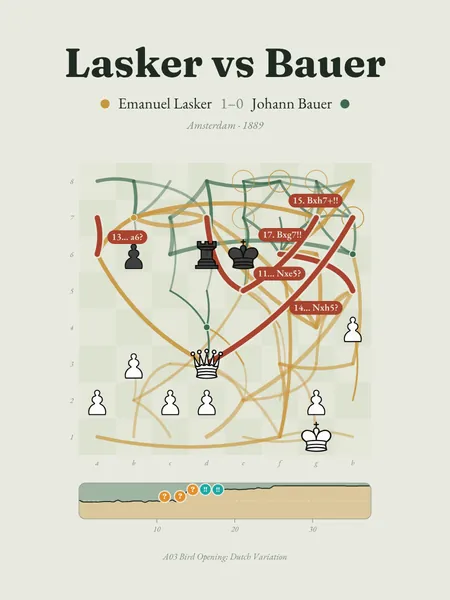
The game is famous for one idea: White gives up both bishops, on h7 and on g7, to strip away the pawns in front of the black king. It wasn't the first time the idea had been played, but it became the best-known example, and Lasker later put the combination in his own Manual of Chess. In September 1889 Wilhelm Steinitz, then world champion, called it "the beginning of a most profound and elegant combination" in his International Chess Magazine.
The opening: a quiet Bird
is the Dutch Variation of the Bird Opening. Both sides develop quietly: . Some sources give the first eight moves in a different order, but all reach this position.
White's bishops on b2 and d3 both aim at the black king. brings the knights toward the kingside. After modern analysis prefers , which kicks the knight off f6 and leaves White clearly better. Lasker took back with the bishop, , which keeps both bishops pointing at g7 and h7 and the game equal.
The mistake: 13...a6
brings the queen closer to h5. Black had to watch his king. , which takes the h5 square away from a white knight, keeps the game equal. gets ready for ...b5 on the queenside, and it allows the combination.
attacks the knight on f6. After the white queen can take back on h5 later, with check, once the bishop has gone to h7. Modern analysis prefers , though White is clearly better there too.
After 14...Nxh5: White to play. Both bishops point at the black king
Two bishops
removes the h-pawn. White is a piece down, and the queen alone can't mate. So Lasker gives up the second bishop: . Modern analysis shows it is the only winning move. A slower move like gives Black time to defend, and Black is clearly better.
Declining doesn't help. and both end in forced mate.
is the point. The g- and h-pawns are gone, and White threatens Rh3+ with mate. is Black's only defense: it opens the sixth rank, so the queen can block on h6. Against anything else, for example , White mates within three moves.
The fork that wins it
leaves Black with two rooks and two bishops against a queen and a rook. is the last trick: the queen forks the bishops on e7 and b7, and one of them falls.
After 22. Qd7: the queen forks the bishops on b7 and e7
After White has a queen, a rook and eight pawns against two rooks, a bishop and six pawns, and modern analysis shows White winning.
The finish
The rest is clean technique. opens the f-file, and after the pawn attacks f7. gives back the rook to bring the queen into Black's camp with check: .
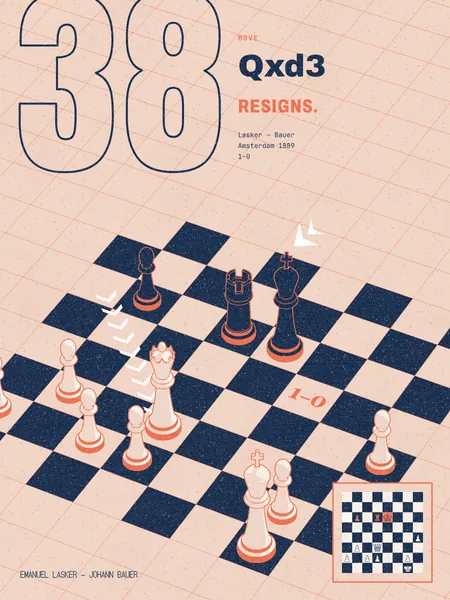
White has given a rook and taken a bishop and a rook, and the game is a queen against a rook. , and Bauer resigned.
Final position: a queen and six pawns against a rook and a pawn
What to take from it
Count the pawns in front of the king. Lasker's sacrifices won two pawns, h7 and g7, and that was enough: with the g- and h-pawns gone, the king couldn't hide from a queen and a rook.
Bring the rook up the board. 19. Rf3 and 20. Rh3+ are as important as the sacrifices. When you open a king, look for the next piece that can join the attack in one or two moves.
Look for the fork at the end. After a long combination your opponent often has many pieces for your queen. 22. Qd7 shows why you should look for one more double attack before you stop calculating.
This game as a poster
Made with Posterage, our sister site: pick a style and colors, then print it.
Keep learning
- Bishop sacrificesSacrifices on h7, g7 and f7 that strip the king's pawn cover, the idea behind 15. Bxh7+ and 17. Bxg7.
- Bird OpeningOur guide to 1. f4. This game is its Dutch Variation, 1...d5, the most common reply at club level.
- Lasker's Manual of ChessLasker shows this combination himself, from the diagram before 15. Bxh7+, in his 1927 book.
- Lasker vs. Capablanca, 1914Lasker 25 years later, as world champion, winning a quiet endgame against the next champion.
Questions
Was Lasker the first to sacrifice both bishops like this?
+
No. The chess historian Edward Winter points to Amos Burn against John Owen, Liverpool 1884, five years earlier. Lasker's game is the famous one. The pattern has come back in master games since, among them Nimzowitsch against Tarrasch at St. Petersburg 1914.
Could Black have declined the second bishop?
+
Not usefully. After 17. Bxg7, modern analysis shows forced mate against both 17...f5 (18. Be5) and 17...f6 (18. Rf3). Taking the bishop, as Bauer did, at least gave him material for his queen.
Where did Black go wrong?
+
On move 13. Modern analysis shows 13...g6 keeping the game equal, while 13...a6 lets White start the combination with 14. Nh5. From then on White is winning.
The game score is public domain. Notes by Chessage, with every variation checked by a chess engine.