The moves
Click any move to see it on the board, then step through the game with the arrow keys or the buttons under the board.
Who played it and why it's famous
St. Petersburg 1914 was played in two stages. Eleven players met once each, and the top five went on to a double round-robin final, with their scores carried over. José Raúl Capablanca, 25 years old and unbeaten in the first stage, began the final a point and a half ahead of the world champion, Emanuel Lasker.
This was their meeting in the seventh round of the final. Lasker practically had to win. He chose an opening that trades queens on move six, the kind of simple position Capablanca was famous for. He won, Capablanca lost his next game to Siegbert Tarrasch, and Lasker took first place, half a point ahead. Capablanca published his own notes to the game in his book Chess Fundamentals. They are unusually frank: he calls his play "of an altogether irresolute character".
The opening: an Exchange Ruy Lopez
is the Exchange Variation of the Ruy Lopez. White gives up the bishop pair for a better pawn structure. trades the queens. White now has four pawns against three on the kingside. Black's extra pawn on the queenside is doubled, so it is worth much less.
is where the fight starts. Capablanca thought 10. f4 weak, and modern analysis agrees that White had better moves: after it, Black has a small edge. Then came .
12. f5: a hole on e6
looks ugly. The e-pawn can never be guarded by a pawn again, and the e5 square is free for Black. Capablanca wrote that he would like nothing better than to have such a position again. But modern analysis shows that 12. f5 was White's best move, and the position is equal.
The point is e6. Black has no d-pawn on d7 and no f-pawn on f7, so no black pawn can ever attack a piece on e6, and the pawn on f5 will support it there.
Capablanca lets the knight in
is the first slip. Capablanca himself wrote that the right move was , and modern analysis agrees: after the position is equal. The game went . Capablanca admitted he had missed this move.
After 15. Nd4: the knight heads for e6
Even now Black could guard e6. keeps the bishop on the c8–h3 diagonal, and the game stays close to equal. After the knight is in, and White is slightly better.
A knight on e6
After 16...Rd7: the knight on e6 attacks c7, d8, f8 and g7, and no pawn can touch it
The knight stood on e6 for 21 moves, cutting Black's position in two.
is the second slip. Capablanca wrote that he was about to play 17...c5 and ...d5, which he thought would draw, but suddenly became ambitious and played for more. Modern analysis rates better, though White is slightly better either way.
For many moves Black's best practical chance was the exchange sacrifice ...Rxe6, giving a rook for the knight and a pawn. Capablanca planned it, then changed his mind. After , for example, leaves White better, but with a long fight ahead.
The kingside break
Lasker used the time to open a second front: . Now White is clearly better.
is the decisive mistake. Modern analysis shows that was Black's last chance, still clearly worse but fighting. Now gives White the h-file, and after both white rooks stand on it.
The finish
is the cleanest win. White gives up the pawn so that the knight on c3 can come to e4. After the knight finally leaves e6, to win the exchange: .
and Capablanca resigned. The bishop on c8 is pinned, and White threatens Nb7+ or Ne6+ followed by Rxc8 mate.
Final position: Black resigned, with Nb7+ or Ne6+ and Rxc8# coming
What to take from it
A pawn move can make a hole for good. 12. f5 gave up e5 and left the e-pawn weak, but it made e6 a square that Black's pawns could never cover again. Before you judge a pawn push, ask which squares it takes away from your opponent forever.
Guard the square before the piece arrives. Capablanca could keep the knight out with 13...Bxf4 or 15...Bc8. Once it landed on e6, Black never got rid of it.
Pick a plan and carry it out. Capablanca's own verdict was that he kept changing his plan. In a slow position, one plan played with purpose beats switching between good ideas.
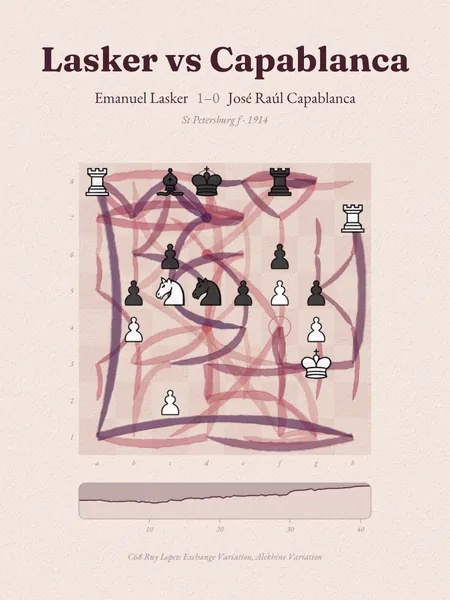
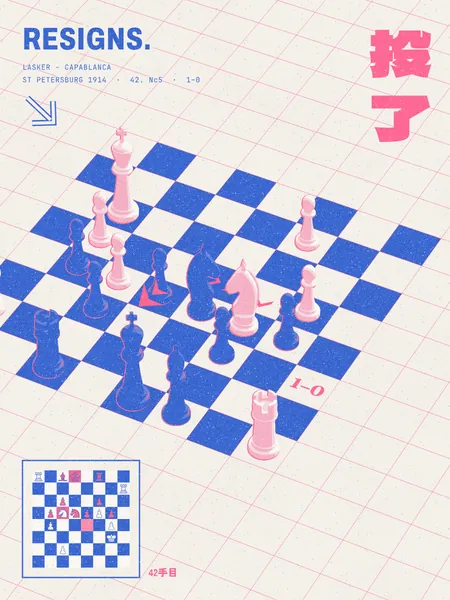
This game as a poster
Made with Posterage, our sister site: pick a style and colors, then print it.
Keep learning
- Weak squares and holesOur chapter uses this game to show how 12. f5 made e6 a hole that no black pawn could ever guard again.
- Knights and outpostsWhy a knight on a square like e6, which no pawn can attack, can be worth more than a rook.
- Ruy Lopez: Morphy DefenseOur course for Black, with the Exchange Variation, 4. Bxc6 dxc6, and the answer 5...exd4 to Lasker's 5. d4.
- Chess FundamentalsCapablanca's own notes on this game, from his 1921 book, where he explains the mistakes that lost it.
Questions
Why was this game so important?
+
It decided the tournament. Capablanca had led after the preliminary stage, and Lasker had to win to have a real chance of first place. He won, Capablanca lost his next game to Siegbert Tarrasch, and Lasker finished first, half a point ahead, 13½ to 13.
Was 12. f5 a mistake?
+
Capablanca thought so and wrote that it took several mistakes on his part to lose the position. Modern analysis shows that 12. f5 was White's best move and the position about equal. It gave up the e5 square, but it made e6 a permanent home for a white knight.
Why did Capablanca resign after 42. Nc5?
+
The bishop on c8 is pinned by the rook on a8, and White threatens 43. Nb7+ or 43. Ne6+, followed by Rxc8 mate. Modern analysis shows Black is lost whatever he plays.
The game score is public domain. Notes by Chessage, with every variation checked by a chess engine.