The moves
Click any move to see it on the board, then step through the game with the arrow keys or the buttons under the board.
Who played it and why it's famous
José Raúl Capablanca and Frank Marshall met in the first round of the Manhattan Chess Club Masters tournament in New York, on October 23, 1918. Marshall was the US champion. Capablanca had beaten him in a match in 1909, eight wins to one with fourteen draws, and, by his own account, had not played a serious game for nearly two years.
In his book My Chess Career Capablanca wrote that his first surprise came on move 2: for the first time in ten years, Marshall let him play a Ruy Lopez. On move 8 Marshall played the gambit that now carries his name, the Marshall Attack, and Capablanca knew he had walked into prepared analysis. He took the pawn anyway, defended for twenty moves and won. He went on to win the tournament, with nine wins and three draws.
The opening: the Marshall Attack
is the main line of the Ruy Lopez. The quiet way on is 8...d6, the Closed Ruy Lopez. gives up the e5 pawn to open lines toward the white king.
After 8...d5: the Marshall Attack
wins the pawn. In return Black gets quick development, and his knight, bishops and queen can all reach the white kingside in a move or two. Modern analysis rates the gambit as sound: White is only slightly better after 8...d5, about as much as after Black's quieter moves.
was Marshall's move in this game. It is not the best version of the attack. , which Marshall himself later preferred, is today's main line.
The attack
starts the onslaught. The knight can't be taken: after the black queen comes in on h2, and Black is clearly better. defends and counterattacks at once. It hits the rook on a8 and eyes f7. opens the line for the bishop on c1.
is the big try. Capablanca called it "the trapper trapped". The knight takes on f2 and the black pieces swarm around the white king. Modern analysis shows that Black should have kept the pressure on more quietly with , as Capablanca himself suggested in the tournament book. After the game's move White is clearly better.
After 15...Nxf2: White to play. Capablanca has to find 16. Re2
is the best defense. It guards the second rank, and the knight on f2 is now attacked by the queen and the rook. was less good. Capablanca thought would win for Black there. Modern analysis shows White still better, but by less than after 16. Re2.
The only move: 17. hxg4
offers the bishop, and the queen on f3 is attacked. takes it. Capablanca wrote that 17. Qxf2 was also possible, but modern analysis shows that after Black is better. Taking the bishop was White's only good move.
gives back the knight and wins the rook. White now has two minor pieces for a rook, and his king is in the open, but his queen on f3 covers it.
The king walks to safety
takes the king across the board to c2, where, as Capablanca put it, it is safe. Marshall still has checks and threats, but no way to get more pieces into the attack. . "At last White assumes the initiative," Capablanca wrote.
After 28. b4: the white king is safe on c2, and White takes over
White's queenside and the finish
brings the rook from a1 into play. After the pawn is one step from queening.
attacks the queen, and finishes the game. Marshall resigned. Taking the bishop, , lets the b-pawn queen with check: .
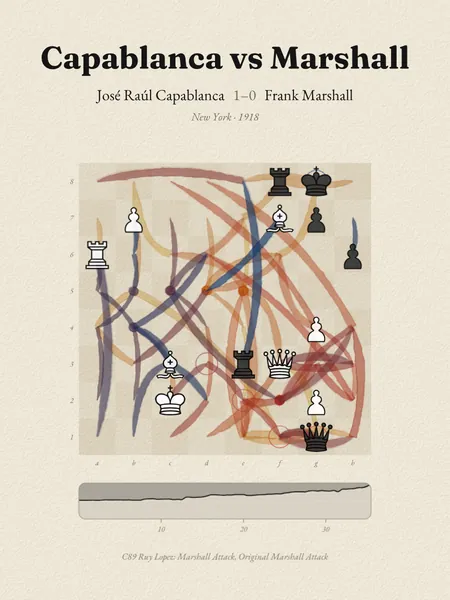
Final position: Black resigned, facing mate
What to take from it
Defend with your best pieces. Capablanca's queen on f3 held the whole position. It defended the king, eyed f7 and the rook on a8, and stopped Black's attack from ever becoming mate.
Take the material when your judgment says you can. Capablanca knew he was in prepared analysis, but he judged that White's position could be defended. When you meet a gambit you don't know, ask what the extra pawn costs you and where your king will be safe.
Get the king out of the line of fire. 23. Kd3 and 24. Kc2 looked risky, but they took the king to the side where Black had nothing. Once it was safe, White's extra pieces decided.
This game as a poster
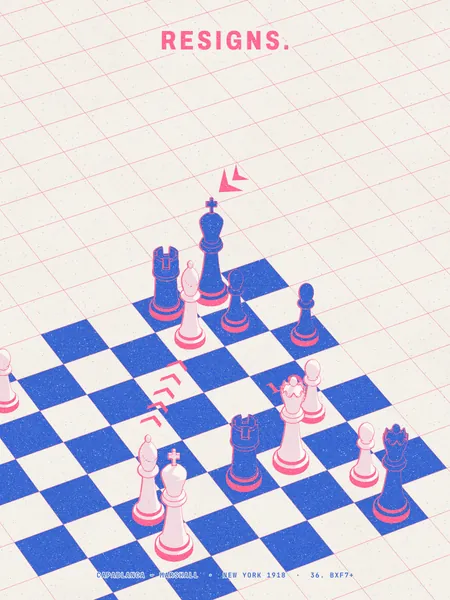
Made with Posterage, our sister site: pick a style and colors, then print it.
Keep learning
- Ruy LopezOur guide to 1. e4 e5 2. Nf3 Nc6 3. Bb5, with the history of its named lines, the Marshall Attack among them.
- My Chess CareerCapablanca's own notes on this game, from his 1920 book, written two years after he played it.
- Defending against an attackHow to survive an attack like Marshall's. Capablanca's defense rested on his queen on f3 and the pressure on f7.
- Lasker vs. Capablanca, 1914Four years earlier, Capablanca on the losing side of a quiet endgame against the world champion.
Questions
Did Marshall really save the Marshall Attack for years?
+
That is the legend, and Capablanca himself wrote that Marshall had kept the variation for two years, waiting for a tournament game against him. The chess historian Edward Winter calls the longer versions of the story, seven or ten years, a myth, and points out that similar ideas had been played before this game.
Is the Marshall Attack sound?
+
Yes. Marshall's 11...Nf6 is not the best version, and he later concluded that 11...c6 was better. That move, found in the late 1930s, has been the main line since at least the late 1940s, and modern analysis rates the position only slightly better for White.
How does White mate after 36. Bxf7+?
+
Taking the bishop with 36...Rxf7 allows 37. b8=Q+, and after 37...Re8 38. Qxe8+ Kh7 39. Qfe4+ Rf5 40. Qxf5+ g6 41. Qfxg6# White mates. The king moves lose even faster. Capablanca wrote "mate in five moves", counting from after 36. Bxf7+.
The game score is public domain. Notes by Chessage, with every variation checked by a chess engine.