The moves
Click any move to see it on the board, then step through the game with the arrow keys or the buttons under the board.
Who played it and why it's famous
Hastings 1922 was a six-player double round robin, played at Hastings Town Hall from September 9 to 21. Going into the last round, Alexander Alekhine and Akiba Rubinstein had 6½ points each. Alekhine had to beat Efim Bogoljubow to be sure of first place. Rubinstein drew his last game, so a draw would have meant sharing it.
He did it with one of the most original combinations of his career. Alekhine gives up his queen for a rook so that a pawn can queen on c1, ties White's pieces down, and finally trades the new queen for a pawn ending he can win. Alekhine later named this game and his win over Richard Réti at Baden-Baden 1925 as the two most brilliant tournament games of his career.
The opening: a Dutch Defense
is the Dutch Defense. In his notes Alekhine calls it a risky defense that he rarely played in serious games, but here he needed a win. After Black has traded his dark-squared bishop, a piece with little room in the Dutch.
gets ...e5 in and then stops b4 for a while. After the black queen has crossed to the kingside, and brings both sides' knights forward.
The turning point: 16. f3
chases the knight but weakens White's kingside pawns. Modern analysis prefers , with an equal game. After Black's pawn on e4 cramps White, and Black is clearly better.
opens the center on Black's terms. After White's bishop has gone to h1 so that he can try g4 one day. brings the queen back to the queenside, and wins a pawn. After a black knight sits on d3.
After 28...Nd3: the knight covers c1, where a black pawn will queen
The queen sacrifice
takes a pawn and hits Black's rook on a8. was more stubborn, but Black is winning either way. Now , the strongest move, attacks the white queen. After Black leaves his own queen on e8 to be taken.
is the point, and the only move that keeps Black winning. Black has given up his queen for a rook, but the pawn on c2 can't be stopped. After Black has a new queen.
After 31. Rxe8: Black's queen is gone, and 31...c2 makes a new one
Modern analysis finds the quiet winning too, and a little stronger. Alekhine thought 30...bxc3 much stronger.
Tying White down
brings the second knight in. is the only move that holds out. Other moves lose quickly, for example .
After Black threatens ...Bb5. Modern analysis prefers , but Black stays winning. forces White to give back the exchange. , White's best try, hits the pawn on f5, and Alekhine answers .
After 40...Qe2: every white piece is tied to its post
White has a rook and two knights, but none of them can move safely. After or the black knight jumps in, and White loses material. Modern analysis agrees: every knight or rook move makes White's position worse, and pawn moves only delay the end. The game went . Alekhine warned against , which lets and Ng5+ into the game, and modern analysis rates it much weaker, though still good for Black.
The last queen
trades Black's last knight and breaks up his pawns. Then , far stronger than anything else, gives the queen back. After a third black queen is captured, and only kings and pawns are left.
Black has three pawns against two, and the pawn ending is a win. After White's king has to give way, and Bogoljubow resigned. Modern analysis confirms that Black wins.
What to take from it
Material is a tool. Three black queens were captured in this game: the first on e8, the one from c1 on e2, and the one born on f1. The first bought a pawn that queens. The other two bought a won pawn ending.
A pawn on the seventh rank can be worth a queen. After 31...c2 White had nothing that could stop the pawn. Before you give up a big piece, check that your pawn can't be stopped or blocked.
Count the pawn ending before you trade into it. 47...Qe2 only works because the king and pawn ending is won. When you can count such endings, trading everything off becomes a winning plan.
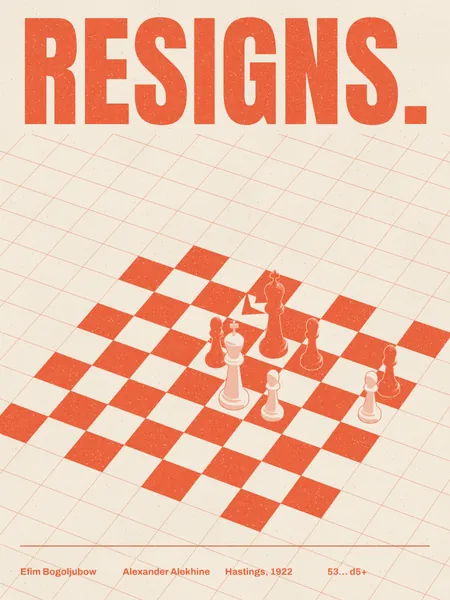
This game as a poster
Made with Posterage, our sister site: pick a style and colors, then print it.
Keep learning
- The game in Alekhine's My Best GamesThe same game with Alekhine's own notes from 1927, in our library.
- Réti vs. Alekhine, 1925The other game Alekhine named as his most brilliant tournament win, with a rook on e3 and a chain of knight checks.
- Dutch DefenseOur guide to 1...f5, the opening Alekhine chose here because he had to play for a win.
- Promotion31...c2 is a promotion tactic. The pawn on the seventh rank is worth more than the queen Black gave up for it.
Questions
Why did Alekhine play the risky Dutch Defense?
+
In his notes he wrote that he had to play for a win to make sure of first prize, while a draw was enough for Bogoljubow to secure third prize. So he chose an opening that leads to an unbalanced game, and took the risks that came with it.
Was 30...bxc3 the best move?
+
It wins, but it isn't the only way. Modern analysis finds the quiet recapture 30...Qxa8 winning too, and rates it a little stronger. Alekhine thought 30...bxc3 was much stronger, and it is the move that made the game famous.
How did Hastings 1922 end?
+
Alekhine won with 7½ points from 10 games, half a point ahead of Akiba Rubinstein. George Thomas and Bogoljubow shared third place with 4½ each.
The game score is public domain. Notes by Chessage, with every variation checked by a chess engine.