The moves
Click any move to see it on the board, then step through the game with the arrow keys or the buttons under the board.
Who played it and why it's famous
Baden-Baden 1925 was a 21-player tournament, played from April 16 to May 14. Alexander Alekhine won it without losing a game, with 12 wins and 8 draws. Richard Réti played him on April 25.
The game is famous for its middle game. Réti refuses a draw by repetition, and Alekhine sets up a combination that runs for fourteen moves: a rook goes to e3, where it can't be taken, knights land on c3 and e2, and a series of checks ends in a fork. Alekhine named this game and his win over Bogoljubow at Hastings 1922 as the most brilliant tournament games of his career.
The opening: an Alekhine Defense in reverse
is the Alekhine Defense with the colors reversed. Black's pawn chases the white knight, as White's pawn chases Black's knight after 1. e4 Nf6 2. e5. White plays it with an extra move, and the black pawn on e4 can become a target.
trades dark-squared bishops, and wins the pawn back. After White's pieces press on the queenside.
The refused draw
offers to trade bishops, and Réti doesn't want to. After the bishops have gone back and forth twice. would have repeated the position for the third time. According to Max Euwe, Alekhine claimed a draw by repetition, and the tournament director ruled that it hadn't happened yet.
After 20. Bh1: Réti avoids the repetition and plays on
Réti chose and played for a win. Modern analysis rates White slightly better after it, so refusing the draw was sound. opens files on both sides.
The rook on e3
is the move the game is known for, and modern analysis rates it Black's best. The rook offers itself on e3, and it can't be taken: after the white king has no pawns left in front of it, and Black mates in a few moves.
After 26...Re3: the rook hits g3, and taking it loses
The position is still about equal. , offering to trade Black's light-squared bishop, was the right defense. Réti played , and now Black is clearly better. recaptures the pawn. was more stubborn, and after the black knights jump in.
The knights' tour
trades queens, and Black's knights now sit on e2 and e4, next to the white king. brings the bishop around with tempo. makes it worse. held out longer, though Black was winning either way.
Now the knights do the rest. takes the knight and leaves the rook hanging on f3. wins the rook on c2 with checks. After the knight attacks the rook on e2 and the bishop on f3 at once, and Réti resigned.
Final position: the knight on d4 forks the rook and the bishop
White can't save both pieces. Modern analysis shows Black winning, whatever White does next.
What to take from it
A refused draw is a game still to be played. 20. Bh1 was sound and kept a small edge. Réti lost because of one wrong defense seven moves later, 27. Nf3.
Check whether an offered piece can really be taken. 26...Re3 looked like a free rook. Taking it opened the white king, and the right answer, 27. Bf3, was a quiet move that traded a key attacker.
Knights near the king can be worse than a rook. From e2, e4, f2 and g4, Black's knights gave check after check. Each check gained a move, and the last one set up the fork on d4.
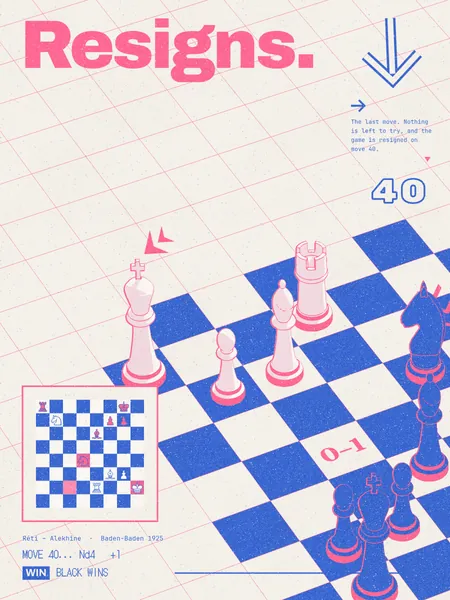
This game as a poster
Made with Posterage, our sister site: pick a style and colors, then print it.
Keep learning
- Bogoljubow vs. Alekhine, 1922The other game Alekhine named as his most brilliant tournament win, with a queen given up for a pawn that queens.
- Alekhine DefenseOur guide to 1. e4 Nf6. After 3. Nd4 d5, Réti has the same setup with the colors reversed.
- ForkThe game ends with 40...Nd4, a knight attacking a rook and a bishop at once.
- Réti vs. Tartakower, 1910Réti on the winning side, in an 11-move Caro-Kann with a queen sacrifice on d8.
Questions
Why couldn't Réti take the rook on e3?
+
After 27. fxe3 Qxg3+ 28. Bg2 Nxe3, the white king has lost its pawn cover, and modern analysis shows mate in a few moves. 27. Bf3, trading off Black's bishop, was the right defense and kept the game about equal.
Why is this game so famous?
+
Alekhine named it, with his win over Bogoljubow at Hastings 1922, as the most brilliant tournament games of his career. He added that no brilliancy prizes were awarded at either tournament. Max Euwe called it the deepest combination with rooks and minor pieces ever played.
Are there different versions of the score?
+
Yes. Old sources disagree on how many times the bishops went back and forth before Réti played Bh1, so the game ends on move 38, 40 or 42. We give the version from Alekhine's own books, the one most sources use.
The game score is public domain. Notes by Chessage, with every variation checked by a chess engine.