The moves
Click any move to see it on the board, then step through the game with the arrow keys or the buttons under the board.
Who played it and why it's famous
Boris Spassky was the world champion and Bobby Fischer the challenger. Spassky won game 1, and Fischer forfeited game 2 by not showing up. Then Fischer won five of the next eight games and drew the other three, and before game 11 he led 6½–3½.
Game 11 was played on August 6, 1972. As in game 7, Fischer chose the Najdorf Sicilian and the Poisoned Pawn Variation, his favorite. In game 7 he had taken the pawn and drawn. This time Spassky surprised him with the knight retreat 14. Nb1, and Fischer didn't find his way. It was the only time in his career that Fischer lost with the Poisoned Pawn in a competitive game.
The opening: the Poisoned Pawn
is the Najdorf Sicilian. After Black's queen hits the pawn on b2 and the knight on d4. takes the pawn. This is the Poisoned Pawn: Black is a pawn up, but the queen is far from home and White gets time to develop and attack.
blocks the b-file, so the queen can't go back that way, and doubles Black's pawns. and the game is level.
The surprise: 14. Nb1
After 14. Nb1: the knight goes home to chase the black queen
goes back to the knight's starting square. It hits the queen on a3 and plans to come back to d2 or c3, freeing the c-pawn. It looks odd, and it surprised Fischer. Modern analysis rates the position about equal after it.
is Black's best answer, and after the game is still level, though was a little more accurate. and the queen guards the c4 pawn.
Where it went wrong
is the first real slip. It pushes the h-pawn but leaves the center to White. , taking the pawn on d5, keeps White only slightly better. After 18...h4 White is clearly better.
is White's best move. The bishop presses on the knight on f5 and the pawn on e6.
is the decisive mistake. The knight on d6 will be a target for White's c-pawn, and the black queen on b4 is still far from home. Modern analysis prefers , which leaves White clearly better but no more. After 19...Nd6 White is much better.
The queen is trapped
brings the knight back into play from b1. and the pawns drive the queen up the board. finishes it. The queen hits the rook on h8 along the long diagonal and guards c5, and the a-pawn is ready to go.
After 24. a4: the black queen on b5 has no safe square
and the queen on b5 is trapped. Wherever it goes, White wins it, at best for a rook with 24...Qxf1+. Fischer took a bishop with 23...fxg4 to get something for it.
Fischer's counterattack
is Fischer's try. The rook comes to h3 to aim at the white king. But White has a queen for a bishop, and the pieces are ready.
goes straight at the black king. It is winning, though was a little stronger. and every white piece joins in. and Fischer resigned.
Final position: Fischer resigned, with only a bishop for his queen and his king open
White threatens 32. Rxe7+, breaking through to the black king. Taking the rook with only opens the king further, and modern analysis rates White winning by a wide margin.
What to take from it
A pawn grabbed with the queen costs time. 8...Qxb2 won a pawn, but Black's queen spent most of the game running from White's pieces. When you grab material with your queen, count how many moves it will take to bring her back.
Retreats can be strong moves. 14. Nb1 sent a knight back home, but it chased the queen and freed the c-pawn. Don't judge a move by the direction it goes.
Check your queen's squares. After 19...Nd6, three pawn moves, a3, c5 and a4, took the queen's squares away one by one. When your queen is deep in enemy ground, count her exits after every move.
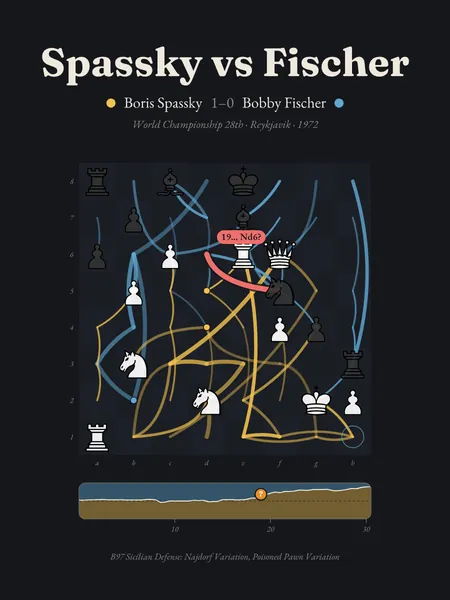
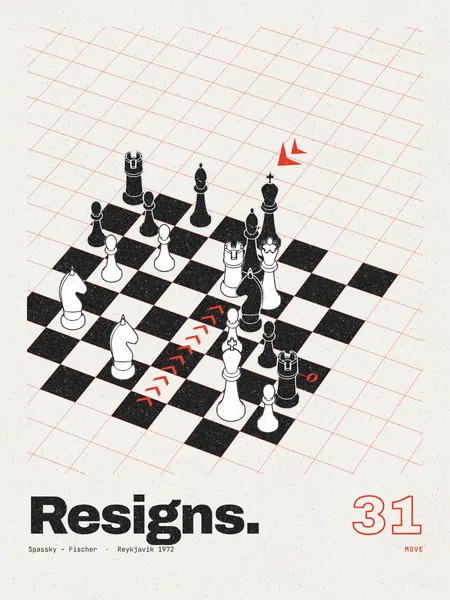
This game as a poster
Made with Posterage, our sister site: pick a style and colors, then print it.
Keep learning
- Najdorf SicilianOur guide to the Najdorf for Black, with the Poisoned Pawn line 6. Bg5 e6 7. f4 Qb6.
- Trapped pieces24. a4 traps the black queen on b5. Learn to spot a piece with no safe squares.
- Spassky vs. Fischer, 1972, Game 13The next game Fischer played with Black. He switched to the Alekhine Defense and won a famous ending.
Questions
What is the Poisoned Pawn Variation?
+
It is the line 1. e4 c5 2. Nf3 d6 3. d4 cxd4 4. Nxd4 Nf6 5. Nc3 a6 6. Bg5 e6 7. f4 Qb6, where Black's queen goes after the pawn on b2. Taking it with 8...Qxb2 wins a pawn but sends the queen far from home, and White gets time to attack. Fischer played it often, and this was the only time he lost with it.
Was 14. Nb1 a winning move?
+
No. It surprised Fischer, and many annotators at the time gave it two exclamation marks, but modern analysis rates the position about equal after it. Fischer's first replies were fine. The game turned on 18...h4 and 19...Nd6.
What did the loss mean for the match?
+
It was Spassky's first win since the first two games, and it cut Fischer's lead to 6½–4½. In game 13 Fischer avoided the Sicilian and played the Alekhine Defense. He won the match 12½–8½ to become world champion.
The game score is public domain. Notes by Chessage, with every variation checked by a chess engine.