The moves
Click any move to see it on the board, then step through the game with the arrow keys or the buttons under the board.
Who played it and why it's famous
David Bronstein was one of the strongest players in the world. In 1951 he drew a world championship match with Mikhail Botvinnik 12–12, and Botvinnik kept the title. Bronstein was also curious about computers, and all his life he took on chess programs whenever he could.
His opponent was the M-20, a Soviet vacuum-tube computer built from 1958 to 1964, which carried out about 20,000 instructions a second. On April 4, 1963, at a mathematics institute in Moscow, it played Bronstein, and the game is the oldest known game between a grandmaster and a computer.
The game is famous because it shows what early programs did. The machine grabbed material when it could: a bishop on move 7, a rook on move 11. It didn't see that its king was being hunted. One account says the computer thought for a very long time over 13...b5, and the game had to be stopped, with Bronstein's next move, 14. Nxg5+, held back the way a move is sealed in an adjourned game. The score that was published runs to mate on move 23.
The opening: a King's Gambit
is the King's Gambit. White offers a pawn to open the f-file and get his pieces out fast. The machine takes it, , and after its knight has to move.
is playable. After the machine goes after material with . The knight attacks the queen on d1 and the bishop on f1.
After 6...Ne3: the knight forks the queen and the bishop on f1
was the simple answer. After 7...fxe3 White is much better. Bronstein had a different plan. saves the queen and leaves the bishop on f1 to be taken, and modern analysis rates the game about equal again. The machine took it: wins a bishop, but the knight on f1 is out of play, and White gets time to bring out his pieces. would have kept the balance.
heads for f6. saves the knight, but it is the fifth move with the same piece, and apart from two pawns nothing else in Black's camp has moved. , guarding f6, was better. After the black king has lost the right to castle and stands on e7, next to the white knight on f6. White is winning.
The king hunt
is Bronstein's second offer, this time of a rook. It isn't the strongest move. or would have kept White winning, and after White is only slightly better. So far the machine's greed had paid. The question was what to do after the king stepped away.
takes the rook, and this time the price is the game. or would have brought another piece into play, and White would have had only a small edge. Now the knight sits on a1 and won't move again, and every other black piece is still on its starting square. Modern analysis shows White winning.
After 11...Nxa1: Black is a bishop and a rook up, and White's attack begins
walks the king forward. was more stubborn, but White wins either way. lines the queen up behind the knight on d5, aimed at the king on e6. Now any knight move uncovers check. After White has a forced mate, and Bronstein found the fastest one.
gives up a knight to pull the queen away from d8, where it guarded c7: . The knight has taken two pawns with check and come back to d5, and now .
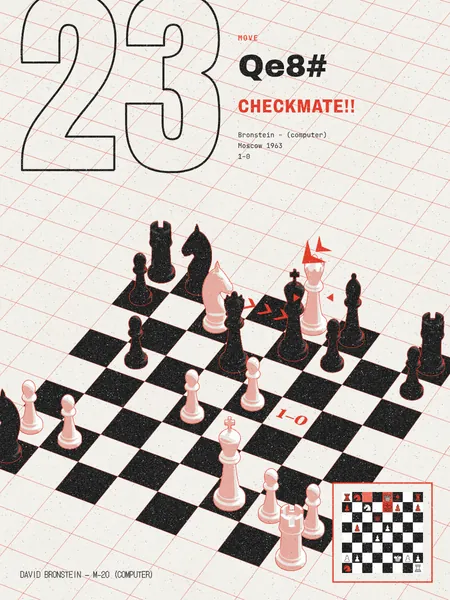
Final position: 23. Qe8 is mate
What to take from it
Material is not everything. The machine won a bishop and a rook and was mated. A knight on a1 does nothing. Before you grab, count which pieces will still be playing after the capture.
Development wins the race. By move 12 every white piece except the rook on h1 was in play. Black had moved his king, two pawns and one knight, and that knight was on a1. When you are ahead in development, look for ways to open the enemy king.
Checks gain time. From move 12 to move 23 most of White's moves were checks, and Black never had time to bring his pieces back. When you hunt a king, every check is a move your opponent can't use.
This game as a poster
Made with Posterage, our sister site: pick a style and colors, then print it.
Keep learning
- King's Gambit AcceptedBronstein's opening. Learn the main lines of 2...exf4 and the attacking ideas behind them.
- Deep Blue vs. Kasparov, 1997, Game 6Thirty-four years later the roles were reversed, and a computer beat the world champion.
- Spassky vs. Bronstein, 1960Another famous King's Gambit with Bronstein, this time on the losing side.
Questions
Is this really the first game between a grandmaster and a computer?
+
It is the oldest one known. Chess programs had been written before 1963, but no earlier game between a grandmaster and a computer is known.
Did Bronstein give the computer odds?
+
Not in this game. Both sides started with all their pieces. One account says that in an earlier game Bronstein played without his queen, and that he broke it off when the machine began to trade down, promising a rematch on equal terms.
Which program was the M-20 running?
+
The sources don't say for certain. The M-20 was a Soviet mainframe of the late 1950s and early 1960s, and more than one chess program was written for it in Moscow at the time.
The game score is public domain. Notes by Chessage, with every variation checked by a chess engine.